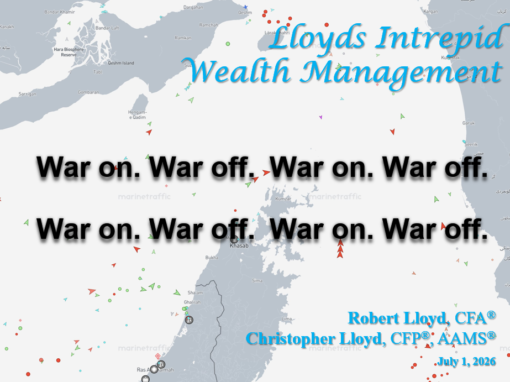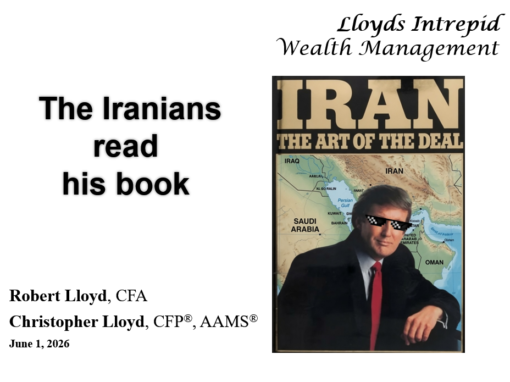

In the 2021 satirical movie “Don’t Look Up!”, Leonardo Dicaprio played a scientist running around the country trying to raise people’s awareness about a comet about to hit planet Earth. We see this same irony in today’s markets; there is a massive energy crisis just ahead of us, but nobody seems to care. Ignoring the oil market disruption, everything seems, well, BULLISH!
Market Update – May 2026
The stock market is looking beyond the US-Israeli-Iranian conflict and is focused on the artificial intelligence trade. After an initial rush of selling, many investors piled back into the semiconductor industry. This industry is up 36% since the end of March and is the most over-bought since the year 2000. Governments are doing what they can to prevent panic. The last pre-war shipments of oil and refined products have been delivered in recent weeks. Strategic reserves are being used if available to support normal economic activity. Bonds are weakening as the reality of the next inflation wave takes shape. Between stimulus and commodity scarcity, the outlook for inflation is higher for longer.
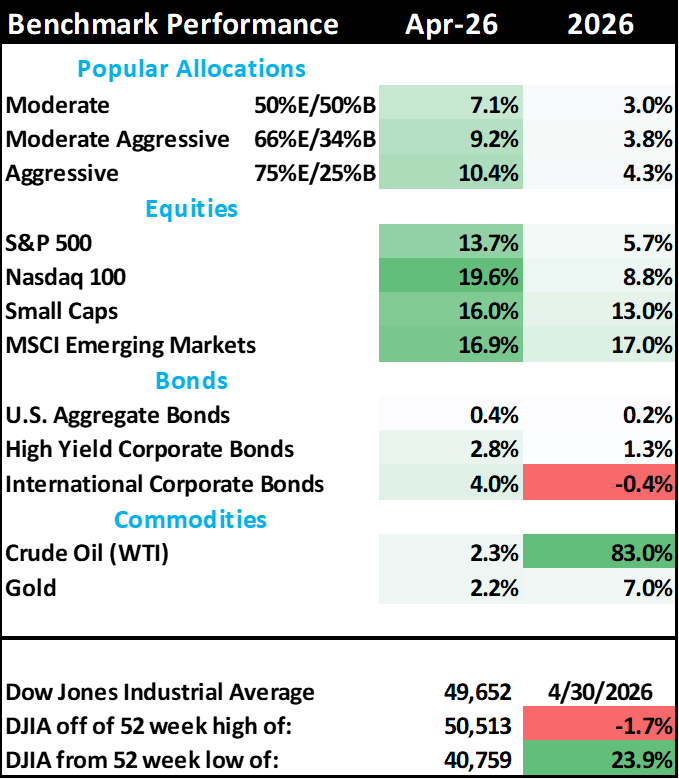
Broad market performance
Table 1: Market performance estimates as of 4/30/2026 (LIMW)
Market Commentary
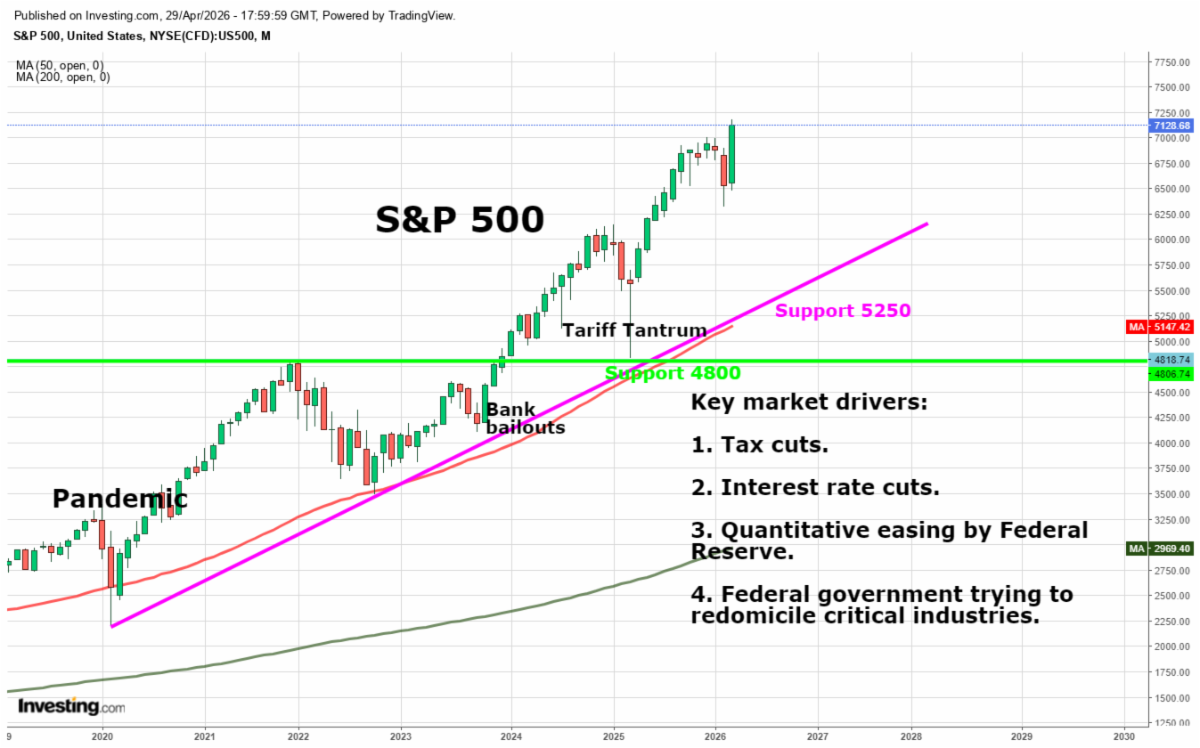
After selling off heavily in response to the US-Israeli-Iranian war, the announcement of a ceasefire April 7th encouraged investors to think that the war was over, that oil was about to start flowing and it was time to buy back into the artificial intelligence trade via the semiconductor stocks. The stock market quickly reached new highs and the semiconductor industry gained 21+% over the subsequent 3 weeks. But why did the market react so positively to the ceasefire? Before the war began in late February, there were many encouraging factors for the market that are still in place: Tax cuts from 2025. Fed rate cuts from 2025. Quantitative easing that started in January 2026. President Trump announced plans to re-domicile critical industries. Earnings estimates marked higher during Q1 2026. The stock market assumed a peace deal meant a return to normality, so investors bought heavily. While the semiconductor industry uses a plethora of chemicals sourced from the Persian Gulf, rumor has it these companies have enough supplies to last a few months. For now, in the developed world, everything appears to be ok.
Figure 1: S&P 500 2019-2026 (LIWM)
Here is what Wall Street sees when they look through the eyes of the analysts. Earnings estimates are up and everything seems fine. Of course, these estimates are always backward looking to a large degree. The stock analysts focus on company nuances and historically demonstrated a poor ability to forecast large changes in earnings or the economy. Will the loss of all this oil supply trigger a Covid-19/2020 style shutdown? Will the market panic if gasoline and jet fuel get rationed? That is the question on everyone’s mind. Look at what the 2020 shutdown did to 2020 earnings.
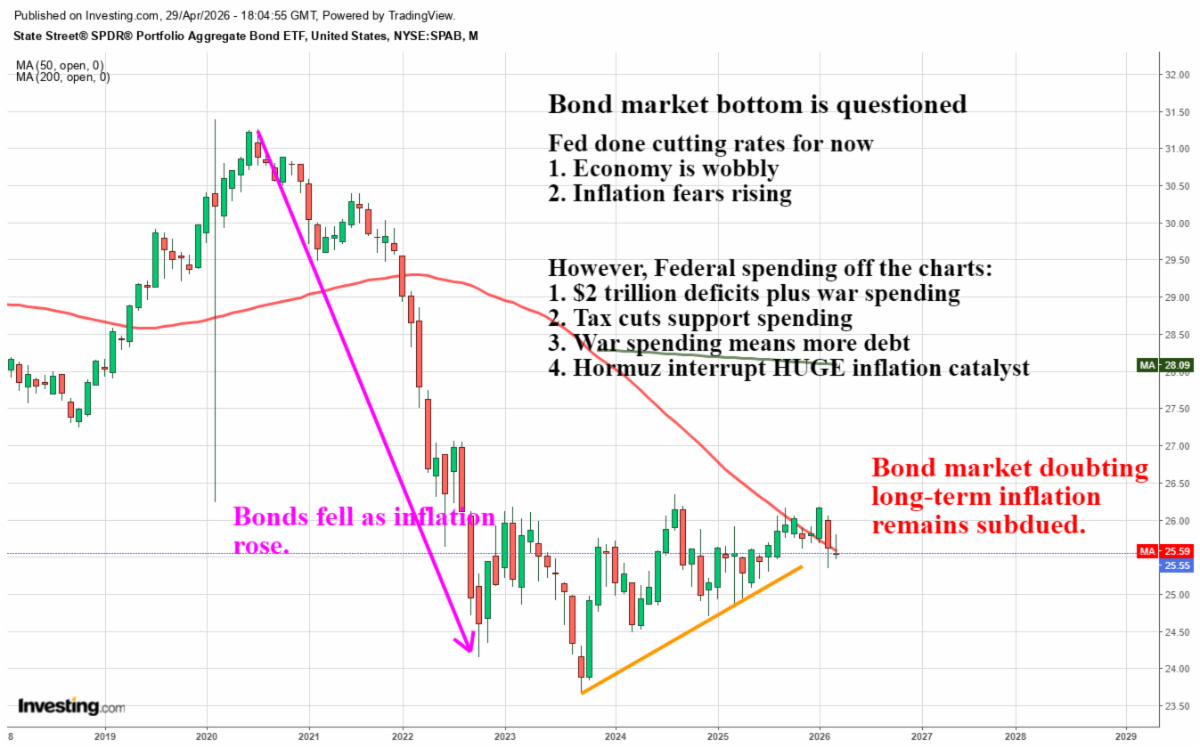
The bond and commodity markets are delivering a very different message than the stock market. Bond investors are worried that a big outbreak of inflation is imminent; commodity investors have moved out of gold and into oil, refined products and agricultural goods.
Figure 2: Aggregate Bond Market ETF 2019-2026 (LIWM)
Semiconductor madness Looking closer at the semiconductors, what can we see? First, the index displays a parabolic rise in the last few months. In market terms, these are very dangerous to trade because they tend to snap back to long-term uptrends that are MUCH lower than the current price.
However, the earnings estimates coming out of this industry are quite strong for now. It is no secret that the massive data center buildout is creating huge demand for logic, storage and memory computer chips. Sharp investors are wondering if there will be a change in the trajectory of data center buildouts. There are limits on electricity and water supply that may prevent the completion of ambitious development plans. So far, investors are not worried about these problems.
In the meantime, the stock reactions to hyperscaler earnings has been interesting. Google and Amazon rallied, while Microsoft and Facebook fell. In general, the stories from each were the same: good overall earnings plus massive spending on AI data centers.
Inflation news is not good In recent years, we had steadily falling inflation. There were hopes that the Fed was managing a return to their long-term 2% inflation target. At this point, it is highly unlikely we see reasonable inflation for a while. The main factors driving inflation have always been central bank stimulus and government borrowing and spending. In January, the Fed restarted quantitative easing and Congress continues to borrow about $2 trillion each year to support the spending budget. European and Asian countries are plagued with similar problems. Politically, there is no will to step back from these policies. Here are two great summaries of what the market is saying about inflation. It is not pretty.
The global oil market is fracturing
In recent decades, we have thought of oil as a global commodity with a common price adjusted for the cost of delivery. In recent weeks, it is becoming obvious that the physical oil market is breaking apart into those regions with plenty of oil and those with a scarcity of oil. Winners: US, Canada and Russia Losers: Europe, Africa, and Asia
Companies are pulling hard on inventory to maintain production at refineries, but this can’t go on forever. Exports of oil and refined products like gasoline and diesel are plummeting. It is only a matter of time before the net oil importers run out of products for their local economies. While the United States generally has a good supply of oil, California and New England are net importers. Prices in these two regions will be set by North Atlantic and Pacific basin supply/demand economics. California will compete with China, Japan and South Korea for fuel; New England will compete with Europe. We expect gasoline and jet fuel prices to skyrocket later this year. Figure 8: Global crude and product exports (Kipler, JP Morgan)
Three possible Hormuz scenarios No war; no peace; no oil For the economy, this is the worst case. The global loss of oil supply and fertilizer will trigger a global recession and famine. India and Africa in particular will be hurt. Expect food, gasoline and all prices to rise dramatically. All the Asian economies will be severely stressed. Russia and the United States will do the best. A lack of resolution means Hormuz stays closed for an extended period. US-Israeli retreat For the economy, this is the best case short-term and long-term. Oil can start flowing immediately and damaged facilities can be rebuilt. Unfortunately, this leaves Iran in control of the Persian Gulf and with their military capability still functional. Expect tolling of ships at the Strait of Hormuz to raise energy prices slightly. US-Israeli victory This result comes with the most uncertainty. Does Iran simply surrender or are they beaten militarily? They have already shown that in a tit-for-tat fight, they can destroy lots of vulnerable civilian plants and infrastructure. Will the Persian Gulf countries be able to quickly resume oil deliveries if their oil fields are damaged? The long-term impact on the economy will depend on how much damage is incurred during the battle and how long it takes to get it back online.
Final thoughts
The energy shock we all think is coming has not materialized in the United States, yet. Hyperscalers like Google, Microsoft, Amazon and Facebook are still increasing their spending on data centers, driving record profits for the semiconductor industry. The stock market is focused on the latter, ignoring the squeeze on the middle-class consumer. Bond markets are beginning to acknowledge that the central banks of the world have no intention of slowing down economic growth or inflation. Yields are creeping higher and investors are beginning to buy exposure in the commodities space. There are some practical steps you can take in this new age of scarcity and inflation: Get your needed home maintenance done now (air conditioners, water heaters, etc). Buy appliance replacements (washers, dryers, refrigerators). Upgrade your car (if you have a clunker, go buy something newer now). Travel (buy your plane tickets now. Avoid Europe and Asia; you may get stuck there if jet fuel gets rationed). Our country is very dependent on Asian manufacturing. If they can’t get raw materials to make things, they won’t have product to sell here in the United States. In many important ways, we are repeating the mistakes and circumstances of the 1970s. Unless we get a drastic change of direction, it seems we are entering a volatile and inflationary regime very different from the 2010s, but similar to the 1970s. As always, we are happy to discuss our research with you and how it affects your situation.
Lloyds Intrepid LLC is an Investment Advisor registered with the State of Texas, where it is doing business as Lloyds Intrepid Wealth Management. All views, expressions, and opinions included in this communication are subject to change. This communication is not intended as an offer or solicitation to buy, hold or sell any financial instrument or investment advisory services. Any information provided has been obtained from sources considered reliable, but we do not guarantee the accuracy, or the completeness of, any description of securities, markets or developments mentioned. We may, from time to time, have a position in the securities mentioned and may execute transactions that may not be consistent with this communication’s conclusions. Please contact us at 281.886.3039 if there is any change in your financial situation, needs, goals or objectives, or if you wish to initiate any restrictions on the management of the account or modify existing restrictions. Additionally, we recommend you compare any account reports from Lloyds Intrepid LLC with the account statements from your Custodian. Please notify us if you do not receive statements from your Custodian on at least a quarterly basis. Our current disclosure brochure, Form ADV Part 2, is available for your review upon request, and on our website, www.LloydsIntrepid.com. This disclosure brochure, or a summary of material changes made, is also provided to our clients on an annual basis.
This update was originally sent as our monthly email newsletter. View the original email.