
Can you name the top internet search engine in the U.S.? If you guessed Google, you are correct; they are #1 with 90% global market share. In the last quarter, Google generated $82 billion from internet advertising revenues. Compare that to #2, Microsoft Bing’s estimated quarterly ad revenue of $5 billion. Do you see why there is a land-rush mentality in the artificial intelligence space? The first one to broadly succeed may grab significant market share for years to come along with the revenues associated with it. There is a severe penalty for losing this race.
Market Update – August 2026
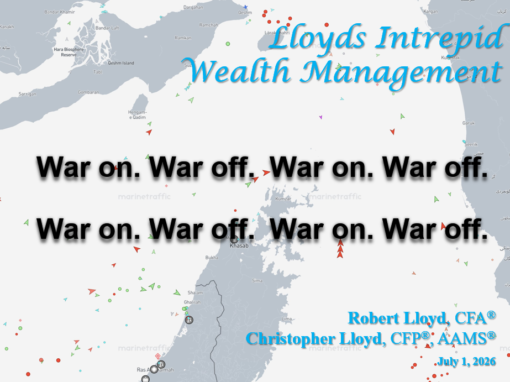
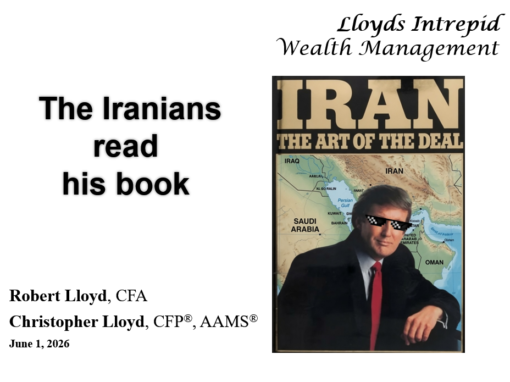
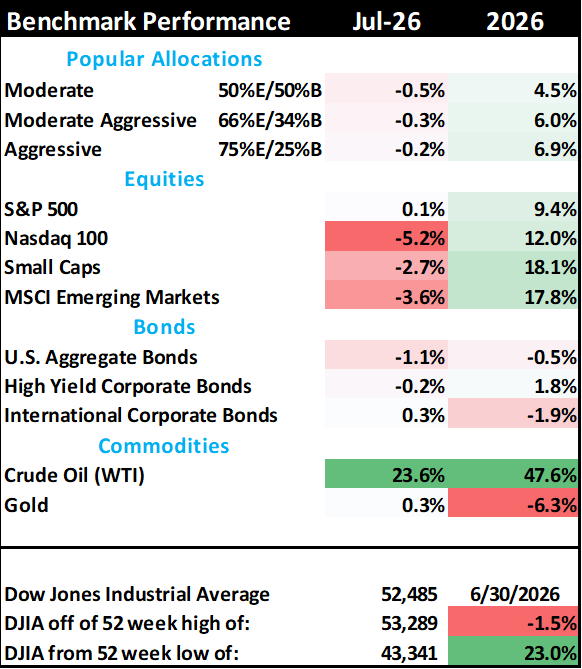
The stock market churned sideways in July. Technology, consumer and communications stocks weakened, while energy and financial stocks did well. The bond market fell after the Federal Reserve meeting on July 29th. While worried about inflation, they don’t want to do anything about it. Bonds sold off in response to this policy decision. The Fed is letting inflation run hot for now. Iran and the United States restarted hostilities in the Mid-East. The Houthis joined the Iranian’s campaign of sea denial by blocking the southern strait of the Red Sea, Bab el-Mandeb.
Broad market performance
Table 1: Market performance estimates as of 7/31/2026 (LIMW)
Market Commentary
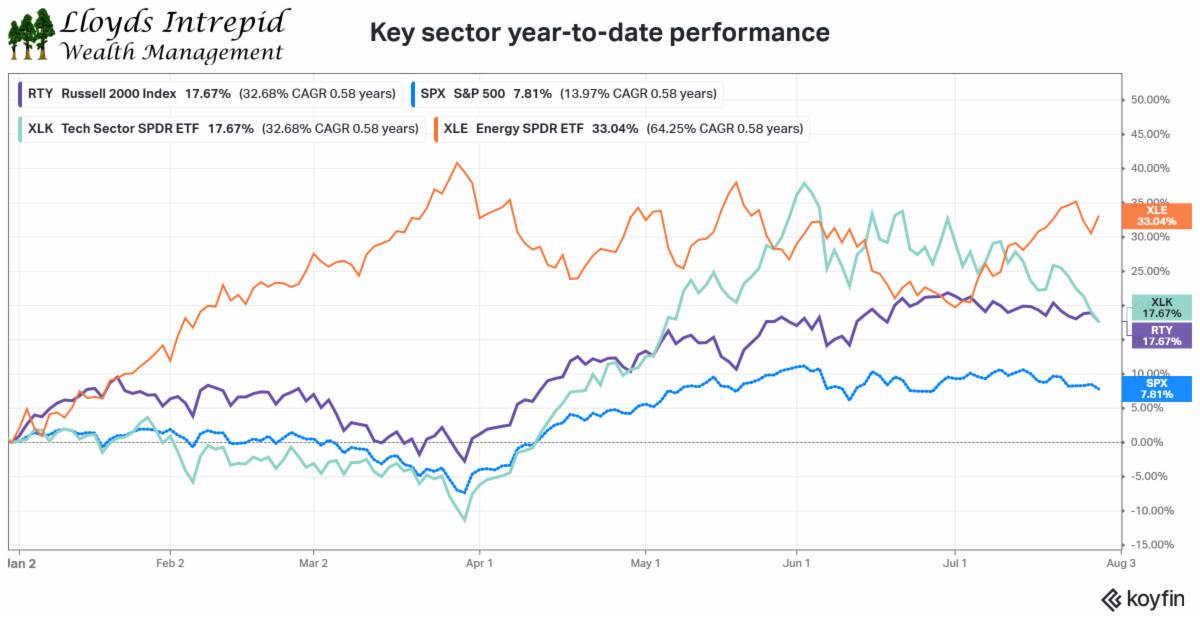
Energy stocks powered ahead in July while the technology sector experienced significant weakness due to the sell-off in semiconductor stocks. For the energy sector, all eyes remain on the Israeli-US-Iranian war. Despite a Memorandum of Understanding (MOU), US and Iranian forces sniped at one another over the last 2 weeks. Strategic petroleum reserves (SPRs) and lower Chinese oil buying have kept crude oil prices in check. However, supplies of diesel and gasoline continue get tighter and there are some reports that the Chinese have re-entered the oil market as buyers. Technology investors experienced an intense sell-off in semiconductors stocks in the US, Taiwan and Korea. While earnings estimates continue to be supportive for these firms, heavy speculation in their stocks drove them up sharply in the second quarter only to give back some of those gains in July. A large hedge fund with $45 billion under management was forced to close on July 29th after leveraged bets on semiconductor stocks turned sour during the month. Margin loan calls forced many to sell, including this large hedge fund.
Figure 1: Key equity markets in 2026: S&P 500, Technology, Small Caps and Energy (LIWM)
Playing for all the marbles in AI In the world of technology, the first firm to gain widespread market share is usually a big winner for decades. Ironically, this doesn’t mean it is the BEST solution, just that it is the one selected by the mass market. Here are a few massive technology firms that started small but have affected all of our lives over the last 50 years: Microsoft’s MS-DOS software and Intel’s 8088 chip selection for the initial IBM PC architecture in 1981 created the “Wintel” standard that dominated the personal computer market for decades. They pushed aside competition from Apple, Commodore, RadioShack and Xerox. Google bought Android in 2005 and offered the software for “free” to cell phone makers globally. Android phones are 72% of the market today and generate massive advertising revenues for Google. Notable early movers Blackberry, Nokia and Microsoft did poorly in this industry despite early leads. Facebook became available to the public in 2006, creating a new type of company that relied on its users to generate content. Today, we call this business model “social media” where the company generates advertising revenue by selling data about its users. Other first movers like MySpace.com and CompuServe have since shutdown. The leaders of today’s technology companies and their investors are intimately familiar with this pattern in technology history. They see how trillion-dollar enterprises were created from new technologies or business models and want that for themselves. Thus, they are investing gargantuan amounts of money to be the FIRST and BEST in the artificial intelligence space (AI). Recently, an analyst at the Bank for International Settlements published a working paper looking at how big the current boom in capital expenditures (capex) compares to other historical periods. Bankers are starting to get worried about the loans and leases supporting data center spending because in the past, investment booms eventually stopped and became busts. At that point, loans get defaulted upon, imposing losses on investors and the banking system. Here are some of his key conclusions: This capex boom exceeds many others in speed and size when compared to GDP. The interlocking leases and loans are very, very large.
Figure 2: AI capex boom compared to prior capex boom episodes (Bank for International Settlements)
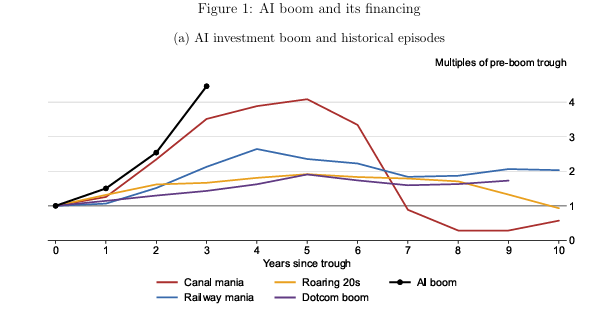
He explains: Technological breakthroughs are typically accompanied by investment booms and buoyant macroeconomic activity. Exuberance about the promise of new technologies intensifies competition among firms eager to capture a share of the revenues. The race to get ahead can result in excessive investment that makes the boom unsustainable and prone to disruption. This fragility is further aggravated by the leverage that accompanies the rapid ramp-up of investment. This boom-bust pattern recurs across history, from the US canal mania in the 1830s and the British railway mania in the 1840s to the roaring 20s and the dotcom boom in the late 90s. These episodes all ended in sharp corrections with wider economic fallout. Relative to its pre-boom trough, the current build-out is on track to outgrow every previous episode in only three years. The rapid capex expansion has led some to resort increasingly to borrowing, not only through bond issuance but also through special purpose vehicles and non-bank lenders. Some firms have also engaged in so-called circular financing, in which a firm engaging in the build-out takes an equity position in an AI lab in exchange for the lab’s commitment to purchase future compute. Such arrangements have enabled greater deployment of capital, but they also create interconnectedness, shown in panel (b) of Figure 1.
Figure 3: AI circular financing (Bank for International Settlements)
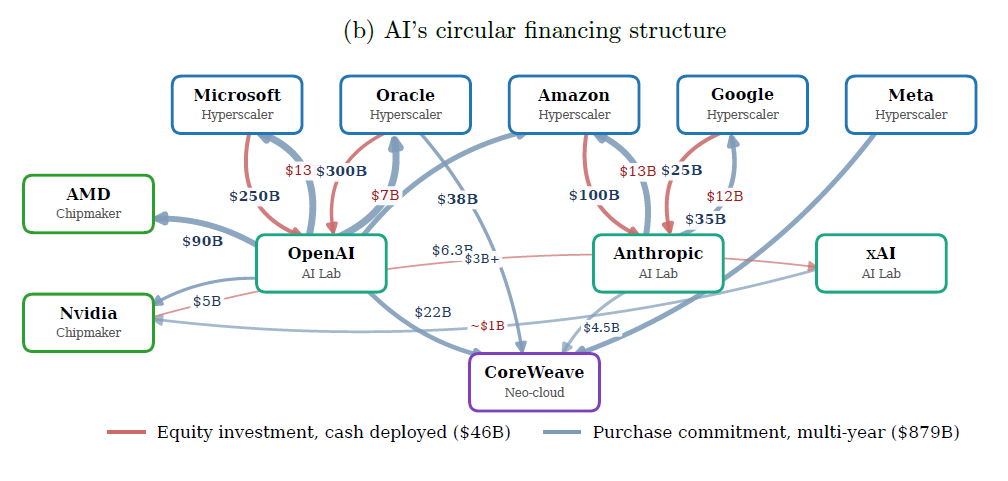
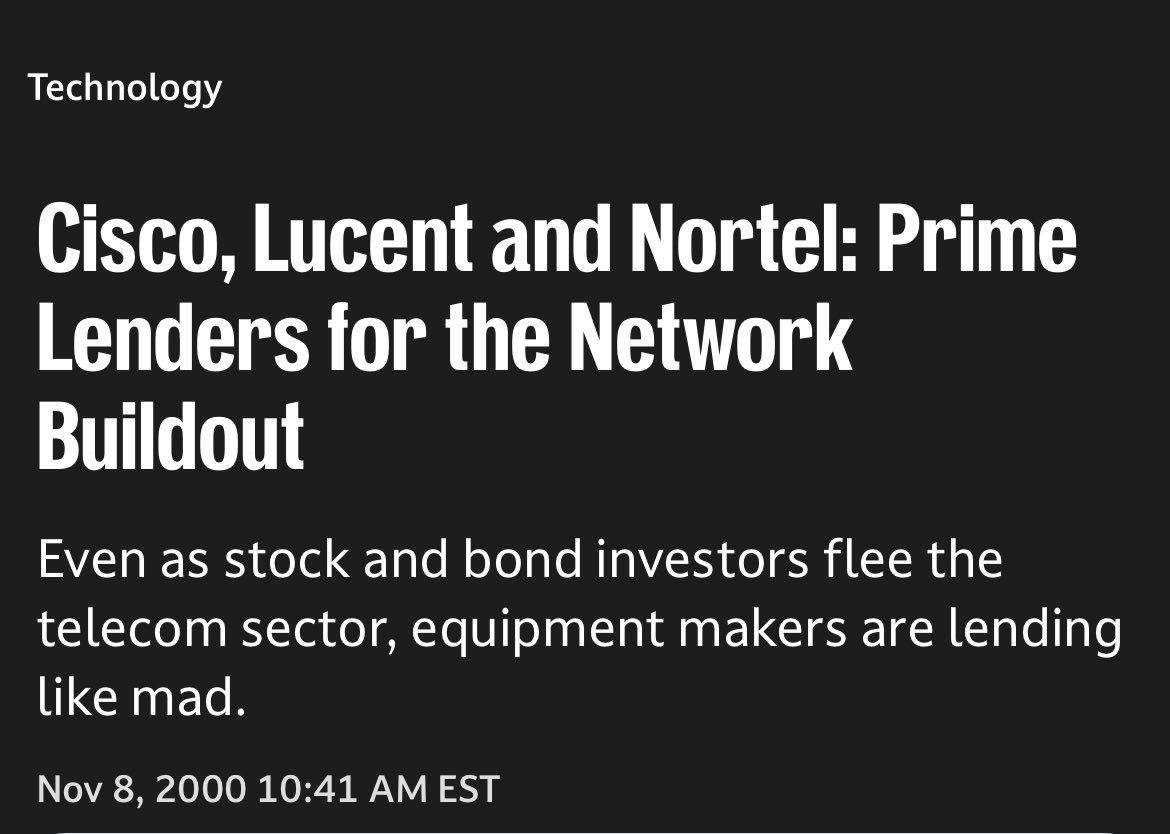
As you can see, there is a complicated web of interlocking investments and commitments. The critical roles are defined here as chipmaker, hyperscaler, AI lab and neo-cloud. All the players are investing and jostling with their competitors to come out on top when this is all over. Hyperscalers Microsoft, Google and Facebook are developing their own AI modules to compete with the AI labs. Oracle and Amazon are primarily building data centers to support AI models. One technique the players are using to gain access and leverage is to lend money to their customers, the AI labs. Lending money to your customer is an old way to stimulate sales for a company’s product, knowing that there is a possibility of not getting paid back. Here is a headline from 2000 that shows how vendor financing was used to help boost sales at the end of the 2000 tech bubble. Lucent eventually merged with Alcatel in 2006 to avoid bankruptcy, while Nortel fell into actual bankruptcy in 2009. This is what the central banks are worried about.
It is too early to tell who the winners will be. Additionally, no one is sure how valuable AI tools will be for the firm that wins. For now, these large companies have the cash flow and incentive to invest heavily to try and win the race.
Fed policy, economic growth and the stock market There are no signs of recession and the Fed is not tightening policy. However, it appears the technology market is overheated and inflation is rising. Let’s compare this to other notable market peaks to compare interest rates, economic growth and the stock market. Here are the proxies we are using for this analysis of 2000, 2008 and 2026: Interest rates – Federal Funds effective interest rate Economic Growth – Institute for Supply Management Purchasing Manager’s Index Stock market – S&P 500 index
Figure 4: The technology bubble of 2000 (LIWM)
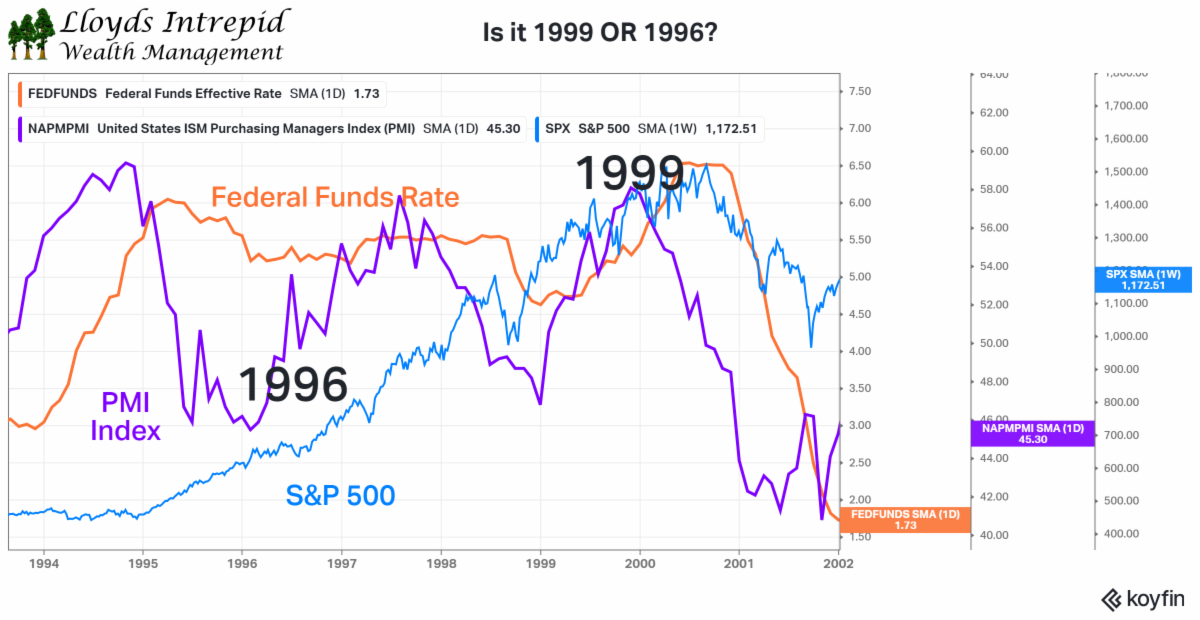
When we look at the bubble top of 2000, we have to think about whether this is 1999 or 1996. In 1996, we had strong economic growth and a neutral interest rate environment. By 1999, the Fed was raising interest rates and economic growth was slowing. As the stock market fell and the economy fell into recession, the Fed cut interest rates aggressively.
Figure 5: The financial crisis of 2008 (LIWM)
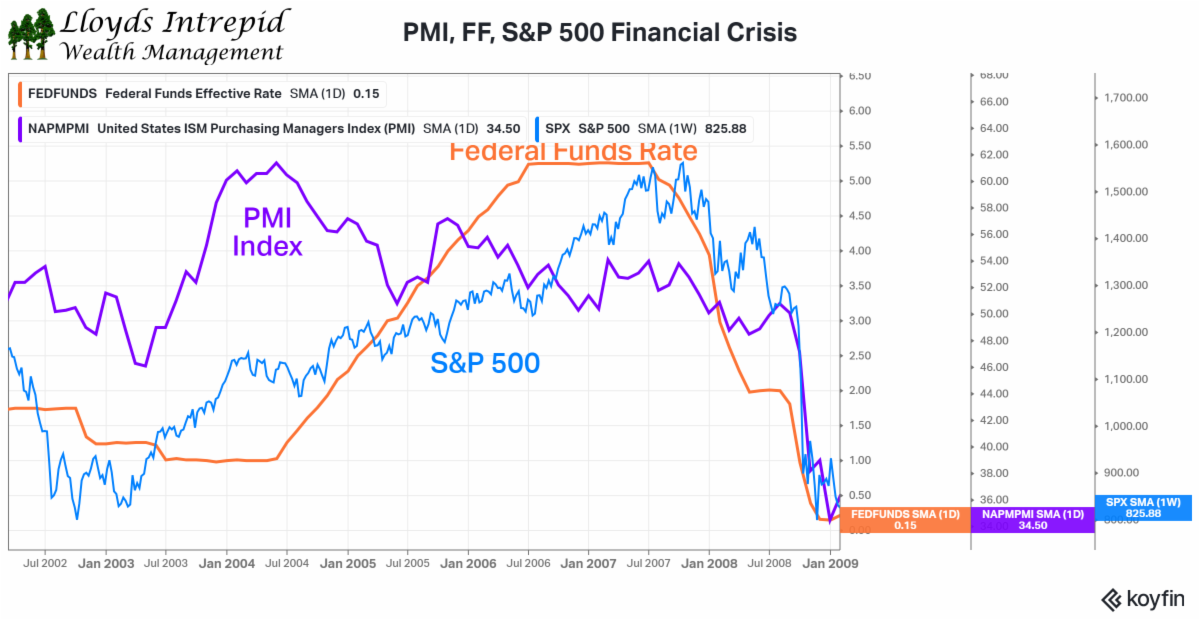
In the years before the financial crisis, we saw the Fed raised interest rates significantly, economic growth slowed, followed by stock market failure as we entered a banking crisis and recession. Once again, the Fed cut interest rates as the market fell and the economy fell into recession.
Figure 6: Today’s situation with same factors (LIWM)
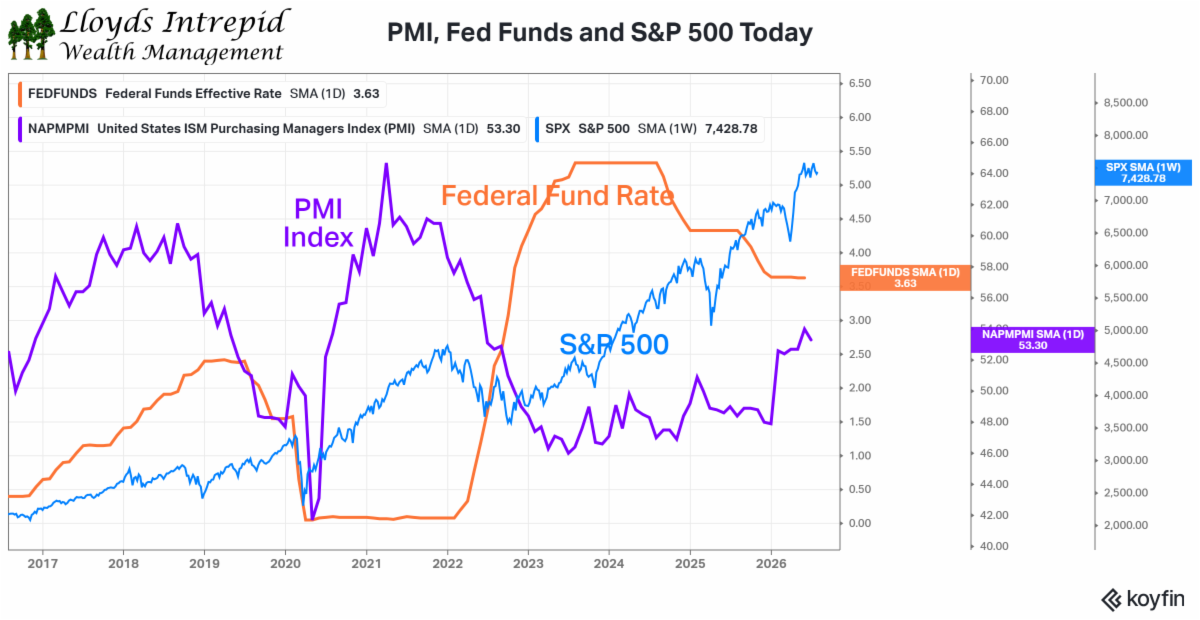
Today, we see that the Fed cut interest rates in 2025 after raising them significantly in 2023. They recently restarted quantitative easing in January 2026, expanding liquidity and perhaps explaining the big runup in technology stocks. Economic growth accelerated gradually over the last few years and the stock market is at all-time highs. Most economic growth today is from the AI investments discussed above. If we ignore the turmoil in the Persian Gulf, we could say things look fine and that a normal 5-10% pullback could be expected before another move higher. It is possible that the crude oil supply disruption becomes entrenched, leading to higher prices, higher inflation and perhaps forcing the Fed to raise interest rates. Investors are struggling with the following dilemma: today, the Fed is NOT fighting inflation and growth seems ok. This is bullish for stocks and bearish for bonds. However, if inflation forces the Fed to raise interest rates, then the situation changes and begins to look a lot like 1999. That means rising interest rates that slow growth and an expensive stock market primed for a correction.
Speaking of oil…
The latest developments from the Persian Gulf have again halted most traffic in the Strait of Hormuz. The Houthis in Yemen are also selectively letting ship get through the Bab el-Mandeb Strait on the south end of the Red Sea. China seems to be getting their ships through as they are supporters of Iran in opposing the West.
Additionally, there are signs that China has started buying crude oil again. This may have a material effect on the global price of crude oil in the coming weeks. There is very little reliable data or reporting on this confrontation in with Iran.
Trump accounts
President Trump has rolled out new savings accounts designed for children. Similar to a traditional IRA, the account can grow tax DEFERRED, but when the money is withdrawn, the profits are taxed as ordinary income. Invested capital is not taxed. These accounts are useful for long-term savings accounts for children. It allows them to save money without earned income in an account that looks like an IRA or 401k.. It is not as good for college savings as a 529 plan where the gains are tax EXEMPT as long as the money is spent on eligible educational expenses. It is another tool in the toolbox. Charles Schwab, our primary custodian, does not currently offer the new Trump accounts. To open one, you need to fill out an IRS form and the government will open one for you at Robinhood or BNY Mellon. Here is a link to the government website to get started and a pdf summary of Trump account features: www.trumpaccounts.gov Trump Child Savings Accounts Summary
Final thoughts
We used July’s weakness in technology stocks to increase our exposure to this sector. Profits and cash flows remain strong in this sector. We reduced our exposure to energy as government intervention has been very successful at managing down the price of oil. We will revisit the sector as the situation with Iran evolves. For now, the stock market is focused on technology and the artificial intelligence race. The bond market glumly resigned itself to the Fed’s current policies. We are very underweight our core bond holdings for this reason. As always, we are happy to discuss our research with you and how it affects your situation.
Lloyds Intrepid LLC is an Investment Advisor registered with the State of Texas, where it is doing business as Lloyds Intrepid Wealth Management. All views, expressions, and opinions included in this communication are subject to change. This communication is not intended as an offer or solicitation to buy, hold or sell any financial instrument or investment advisory services. Any information provided has been obtained from sources considered reliable, but we do not guarantee the accuracy, or the completeness of, any description of securities, markets or developments mentioned. We may, from time to time, have a position in the securities mentioned and may execute transactions that may not be consistent with this communication’s conclusions. Please contact us at 281.886.3039 if there is any change in your financial situation, needs, goals or objectives, or if you wish to initiate any restrictions on the management of the account or modify existing restrictions. Additionally, we recommend you compare any account reports from Lloyds Intrepid LLC with the account statements from your Custodian. Please notify us if you do not receive statements from your Custodian on at least a quarterly basis. Our current disclosure brochure, Form ADV Part 2, is available for your review upon request, and on our website, www.LloydsIntrepid.com. This disclosure brochure, or a summary of material changes made, is also provided to our clients on an annual basis.
This update was originally sent as our monthly email newsletter. View the original email.