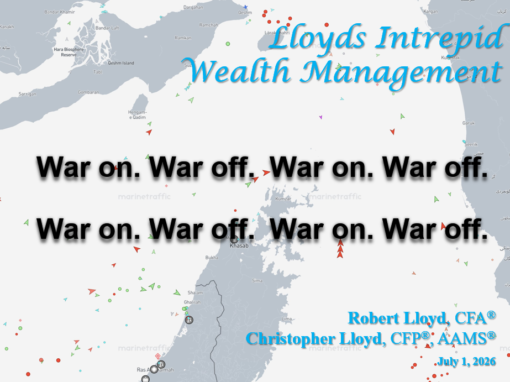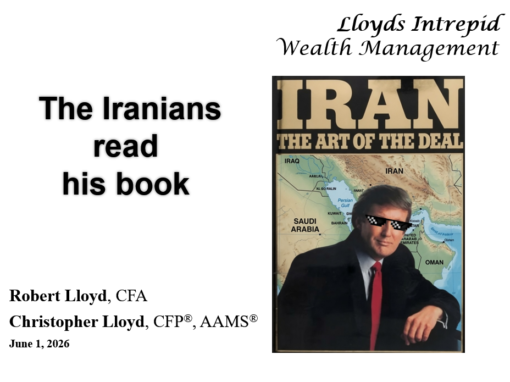
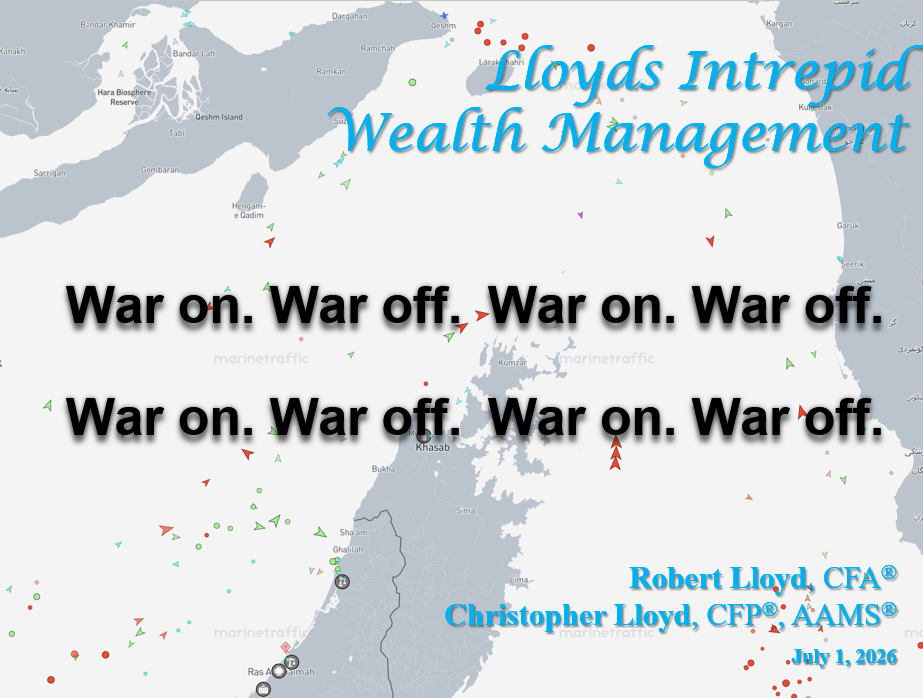
It is difficult to get a clear picture of what is really going on. Despite a recent peace deal signed June 17th, the Iranians have started shooting ships and the United States has launch several air strikes inside of Iran. Ironically, the stock market traded higher on the news.
Market Update – July 2026
The stock market spent most of June churning close to its all-time high. Technology, consumer and energy stocks weakened, generally, while health care and industrials stocks did well. The bond market traded sideways as the market waits for Federal Reserve interest rate cuts. We think that is doubtful as most of the inflation indicators are turning up and economic indicators are strong. Despite a memorandum-of-understanding between Iran and the United States, both countries remain in an escalation trap: neither side has decisively won or lost on the battlefield and there is no desire for peace.
Broad market performance
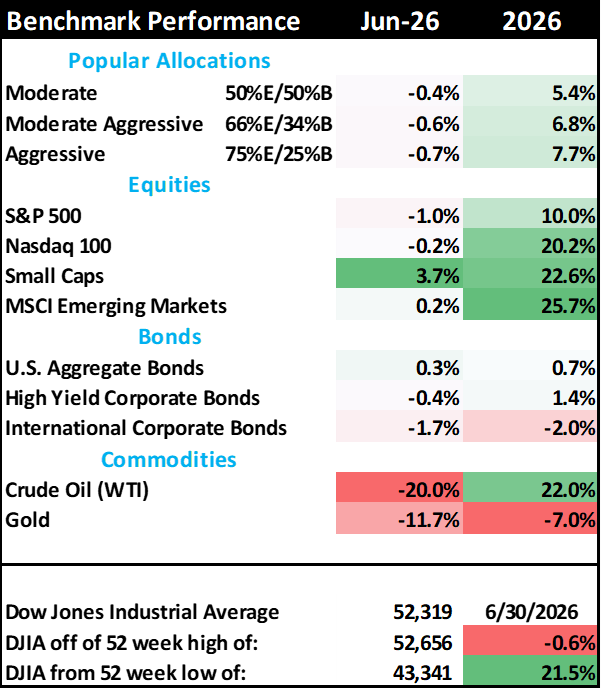
Table 1: Market performance estimates as of 6/30/2026 (LIMW)
Market Commentary
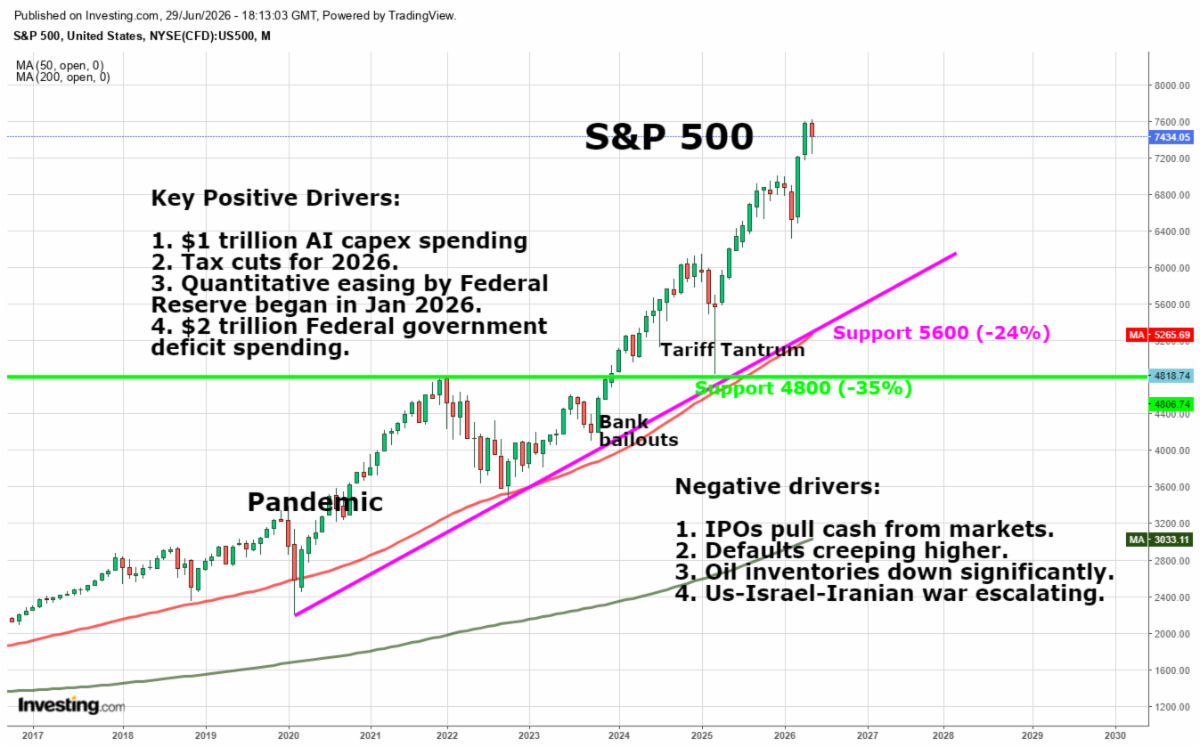
Stocks fell slightly from market all-time highs during June. The market is churning a bit as money rotates from one sector to another. During June, it appeared as though investors were selling their technology, energy and consumer stocks and rotating into health care, financials and industrials. Investors remained focused on the amazing amount of capex committed to artificial intelligence. Additionally, the latest tax cuts and Federal Reserve quantitative easing provided liquidity for the markets. Investor fear about global oil supplies evaporated. Governments have pulled a lot of levers to suppress the price of crude oil by redirecting oil flow, pulling from strategic reserves (SPRs), and reducing purchases.
Figure 1: S&P 500 2019-2026 (LIWM)
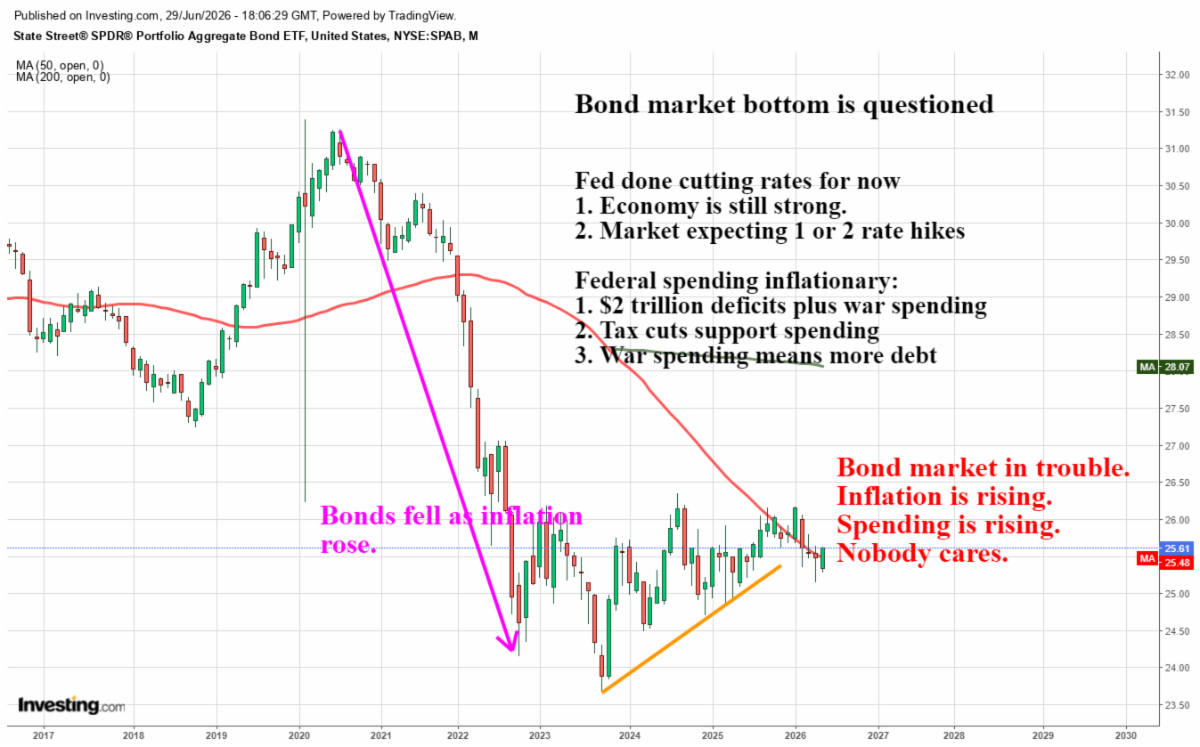
The bond market did not change during the month of June, but we did have a Federal Reserve meeting with the new Fed Chairman Kevin Warsh. He came out swinging on two topics. First, he wants to communicate LESS with the public about policy. That means no more forward guidance and discussions about the future. Second, he is unhappy with the high level of inflation but says it will likely fall in the future. Ultimately, he will have to react to circumstances and the markets as all Fed Chairman have done since the Fed was established in 1913.
Figure 2: Aggregate Bond Market ETF 2019-2026 (LIWM)
Economy charging ahead
Despite the pop in oil prices during April and May, the economy continued to surge forward. Most of this growth came from the buildout of artificial intelligence infrastructure, not consumer growth as in other economic expansions.
There are several ways to measure the economic impact of artificial intelligence capital expenditures (AI capex). One easy way is to take the dollars of AI capex and divide it by national GDP. Using this metric, you can see that the current ratio of AI capex to GDP exceeds all other new technology rollouts including railroads, cars and the 2000 technology bubble. This implies that the revenue expectations for this new technology are very, very high. If consumers and businesses don’t step up to pay for it, expect large write-offs and a massive decline in technology spending.
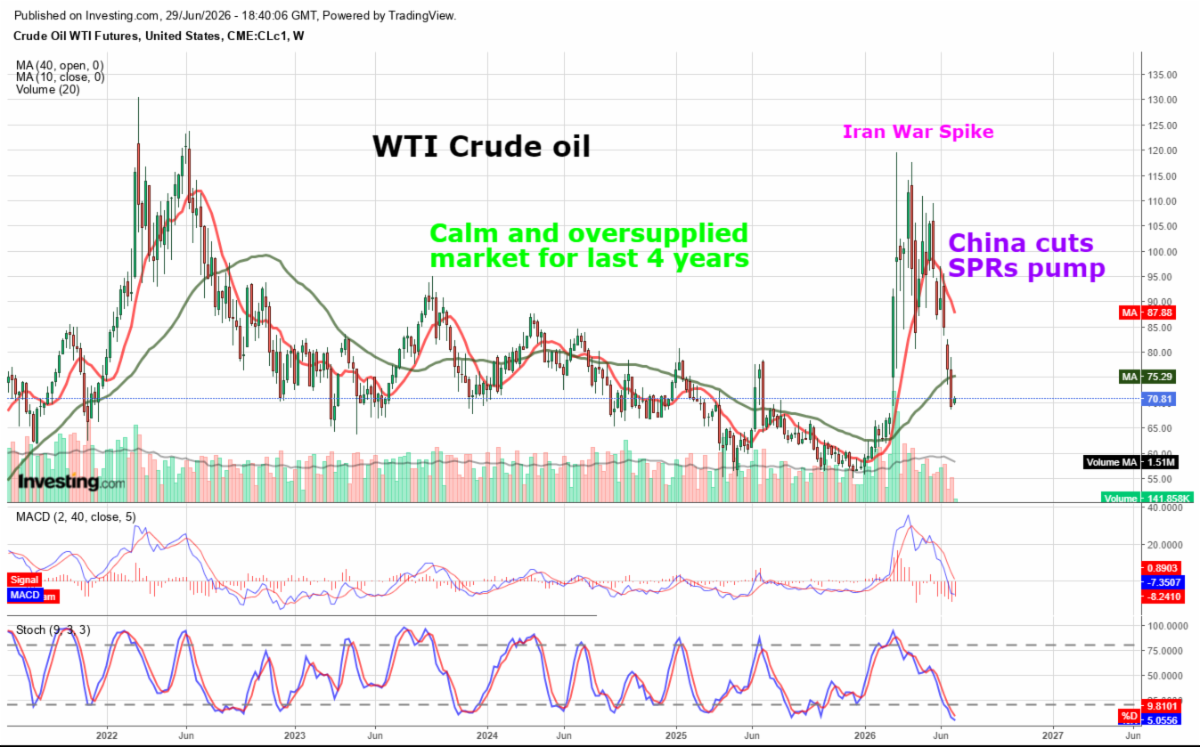
Oil: Double, double toil and trouble In Shakespeare’s play Macbeth, the three witches babble around their boiling pot to come up with a spell that will confuse the king. In a similar fashion, the governments of the world have worked VERY hard to suppress the global price of crude. In recent weeks, there were signs that more ships were risking the Strait of Hormuz transit, so oil started finally to get out. The market is waiting to see if this continues on a regular basis or if the recent fighting scares the merchant shippers away.
However, that still doesn’t explain the dramatic weakness of crude oil pricing in May and June. Theoretically, a dramatic decline in oil supply should have pushed up prices dramatically. However, what we saw was 1) an enormous re-routing of oil around the Persian Gulf, 2) a pull from commercial inventories and SPRs, then finally 3) a dramatic decline in Chinese oil purchases. This last factor is the one that was hidden during April and May. It appears that Chinese oil imports fell ~7 million barrels/day during this period. For those who don’t follow the oil markets, this is an incredibly large number. Forget about OPEC moving the supply of oil up or down by 1-2 million barrels/day anymore; the only thing that matters is what the Chinese are doing. China is the new mystery shopper. When they buy, prices will rise; when they don’t buy, prices will fall. In all cases, expect them to act in their own self-interest.
Let’s have one last look at where oil prices SHOULD be. If we were back under the old paradigm of inventory versus price, Brent crude should be trading in the $115/bbl range. Figure 7: Global oil inventories ex-China v. Brent oil price (Argus)
For now, the crude market is very quiet. Analysts everywhere are looking back and forth between inventory levels and price, wondering what the Chinese will do next. Despite their communist stripes, they are excellent merchantilists.
Figure 8: Gasoline and crude futures contracts for December 2026 delivery (LIWM)
The siren song of Initial Public Offerings It seems to be common knowledge that Initial Public Offerings (IPOs) can be very profitable. Certainly, this is true for the insiders that started a company; maybe for the clients of the investment banks who buy on day one. But for the everyday buy-and-hold investor, holding recent IPO shares has not generated a great rate of return when compared to a standard like the S&P 500. The reason this is true is behavioral. IPOs are like prom; no matter how troubled the teen, a haircut and tuxedo can make someone look attractive and responsible. Wall Street is expert at building excitement and anticipation before an IPO by writing research, conducting analyst interviews and bringing senior management on the road to meet investors.
By the time a firm goes public, expectations for the company are very high. The investment banker’s goal is not only to get a high IPO price but also provide support for the company’s stock price until the investment bank and insiders cash out of their shares. This is why IPO shares frequently see their share prices fall after a year or so. After the insiders and bank clients are all out, there is no need to support the stock. The moral of the story is to be very careful investing in the IPO market.
For those who love the SpaceX story, the best time to buy will probably be July 2027 after Elon Musk’s share lock-up ends. That means he will be able to sell his 46% stake in the company. There are many other smaller lock-ups that expire beginning August 8th, 2026, so the selling pressure will start much earlier. Figure
Inflation and interest rates likely headed higher
The new Fed Chairman is talking about rate cuts, but all the data we see indicate higher inflation pressures. Several forecasters are predicting 2-3 rate INCREASES over the next year. After the Israel-US-Iranian war started, the market began raising its expectations for the Federal Funds rate. The problem is two-fold: 1) the economy is growing robustly, and 2) Persian Gulf shipping interruptions are raising prices in oil, fertilizer, and chemical markets.
For many years, the Fed focused on Core Personal Consumption Expenditures (Core PCE) as well as the Consumer Price Index (CPI). While they tend to talk about whatever metric supports their current policy, it is helpful to look at these traditional measurements as we have lots of historical data to compare it to. Inflation is perking up, sadly; for now the Fed is ignoring these developments.
Another fun way to look at inflation is to compare each year’s inflation with that of the 2010-2019 deflationary period. In the follow chart, the bubble size corresponds to the size of the economy, so it is easy to pick out China and the US versus all the other global economies. It is curious to see persistent inflation in the US and deflation in China.
Final thoughts
The past few months have been very difficult to get right. Who would have guessed that a 20% oil supply shock and mid-east war could be managed this easily by the developed countries of the world? Yet here we are. After a careful evaluation of economic growth, earnings strength, and government support for the stock market, we moved our Dynamic portfolio from underweight up to neutral. We continue to be overweight software, energy, technology, industrials, commodities, gold and health care. The key market drivers for this year will be AI capex growth and a resolution of the war in the Persian Gulf. We are watching both areas very closely. The government support for the stock market does not extend to the energy or bond markets. Expect policies that push down crude and ignore rising inflation. As always, we are happy to discuss our research with you and how it affects your situation.
Lloyds Intrepid LLC is an Investment Advisor registered with the State of Texas, where it is doing business as Lloyds Intrepid Wealth Management. All views, expressions, and opinions included in this communication are subject to change. This communication is not intended as an offer or solicitation to buy, hold or sell any financial instrument or investment advisory services. Any information provided has been obtained from sources considered reliable, but we do not guarantee the accuracy, or the completeness of, any description of securities, markets or developments mentioned. We may, from time to time, have a position in the securities mentioned and may execute transactions that may not be consistent with this communication’s conclusions. Please contact us at 281.886.3039 if there is any change in your financial situation, needs, goals or objectives, or if you wish to initiate any restrictions on the management of the account or modify existing restrictions. Additionally, we recommend you compare any account reports from Lloyds Intrepid LLC with the account statements from your Custodian. Please notify us if you do not receive statements from your Custodian on at least a quarterly basis. Our current disclosure brochure, Form ADV Part 2, is available for your review upon request, and on our website, www.LloydsIntrepid.com. This disclosure brochure, or a summary of material changes made, is also provided to our clients on an annual basis.
This update was originally sent as our monthly email newsletter.