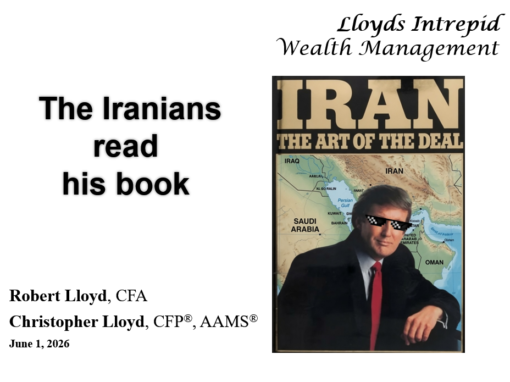
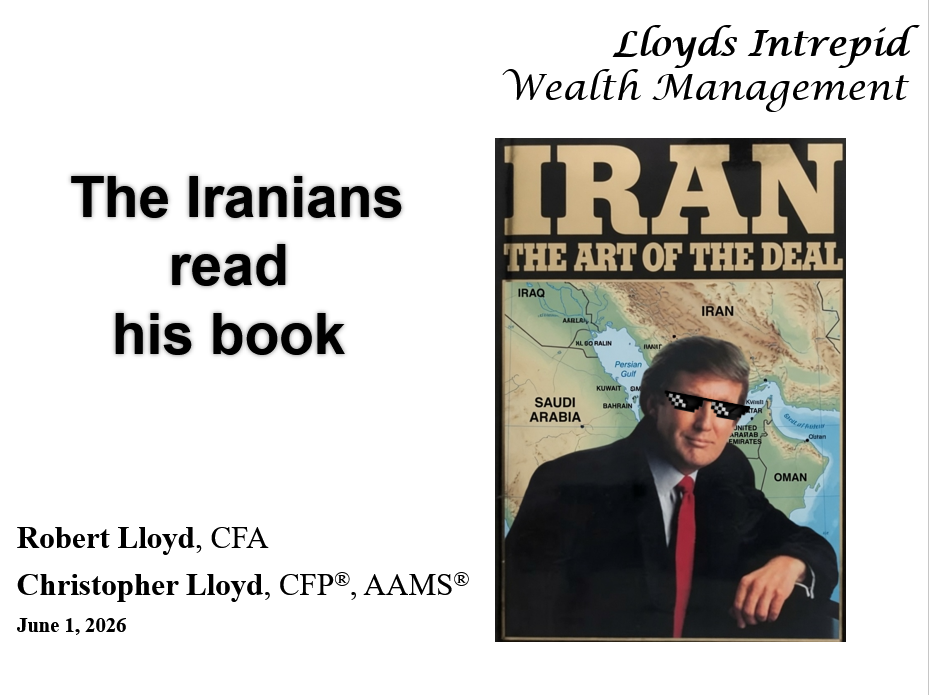
In 1987, Donald Trump published a best-selling book on negotiations. Apparently, the Iranians have read this book, because their successful negotiating strategy to delay a resolution in the Strait of Hormuz is the economic worst-case scenario we discussed last month: No war, no peace and no oil.
Market Update – June 2026
The stock market believes that the Iranian war will not significantly impact the economy nor slow the construction of data centers for artificial intelligence. Energy is a small part of the investing world, so getting the oil call wrong won’t be painful. Missing a move in technology would be very painful. This is why Wall Street is sanguine about Iran. The bond market weakened over fears that central banks and their governments will pursue inflationary policies to support local employment and growth. For example, in the United States the new chairman of the Federal Reserve has discussed rate cuts even in the face of higher inflation and interest rates. Since April 8th, a tenuous cease-fire has held in the Persian Gulf as both sides have demonstrated the ability to create massive destruction of civilian infrastructure such as refineries, water distillation and power plants. It is a strategic stalemate that is choking the world of critical supplies with no resolution in sight. In the United States, life seems normal. Despite some complaints over higher gasoline prices, consumers are spending heavily and employment remains stable.
Broad market performance
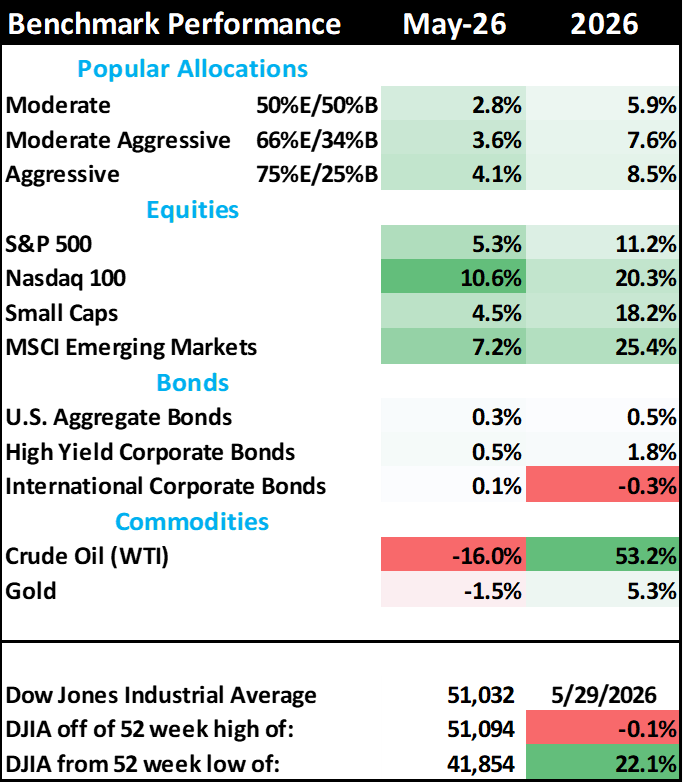
Table 1: Market performance estimates as of 5/29/2026 (LIMW)
Market Commentary
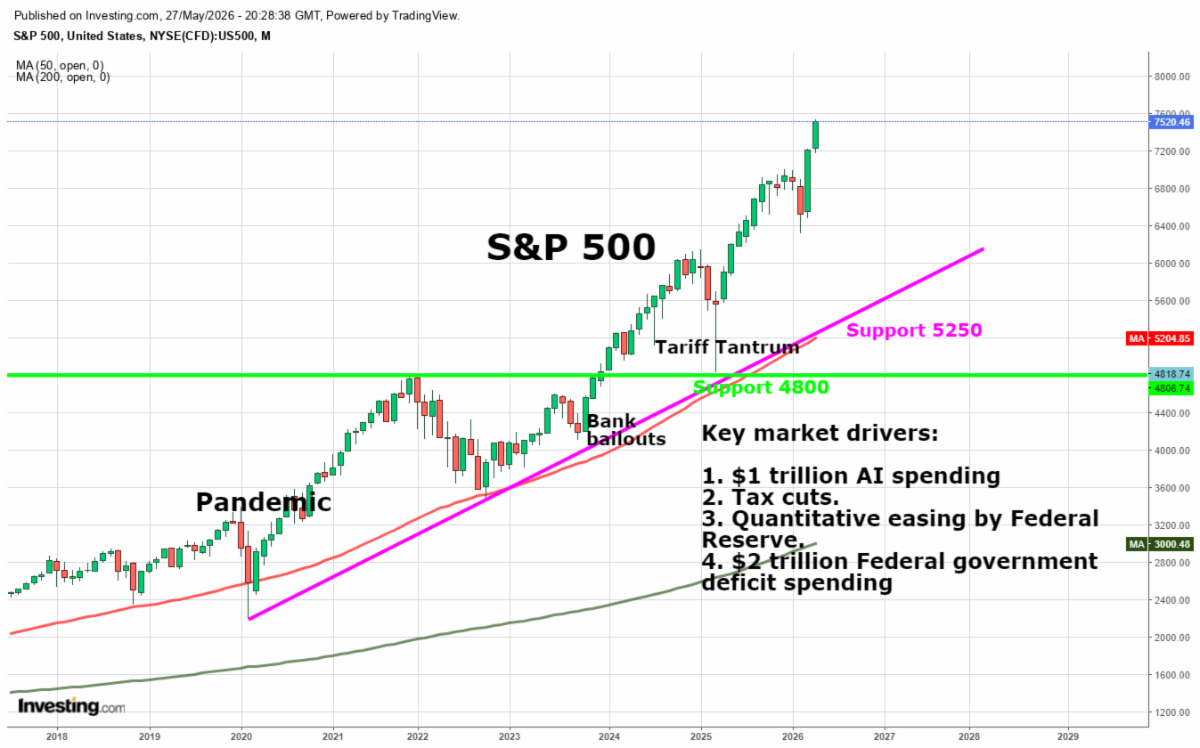
Stocks continued to move higher as artificial intelligence (AI) optimism moved into commodity memory producers like Micron Technology (MU) and Sandisk (SNDK). Many of you are familiar with these names because they have been making chips for our desktop computers for several decades. The key driver for these stocks is the changing blend of demand for computer chips in the AI data center. While Nvidia chips are still important, there are shortages of the other chips widely used to make a data center viable. Investors are chasing these returns as their earnings estimates go up. Caution is warranted here. In the past, violent stock moves upward tend to have equally violent corrections if underlying fundamentals correct and go down. There is an old trader’s adage that applies here: “Stocks do not correct by going sideways.”
Figure 1: S&P 500 2019-2026 (LIWM)
The bond market is driven by a completely different set of factors. First, inflation is rising again. Second, the new Fed Chairman wants to cut rates. Third, long-term interest rates are rising globally as investors doubt governments will rein in spending or inflation. Fourth, tax cuts in the United States are stimulating growth and inflation. This affects the real world through the credit market. Mortgage rates and all other loans will see higher interest rates, lowering the consumer’s ability to borrow and spend. Historically, a contraction in credit was usually enough to slow down the economy and pull down inflation rates. However, with the Fed doing quantitative easing and Congress borrowing $2 trillion/year to support spending, it doesn’t seem like anything stops this train.
Figure 2: Aggregate Bond Market ETF 2019-2026 (LIWM)
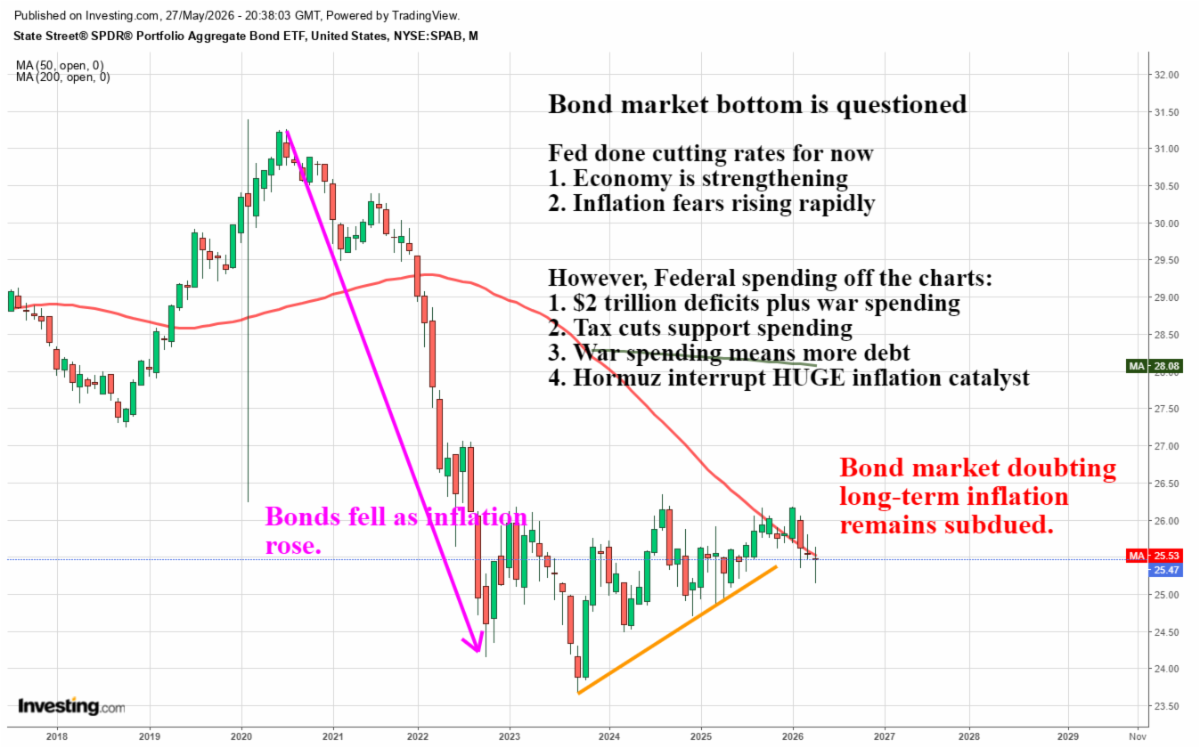
The rise in interest rates is a global phenomenon as most governments and central banks support inflationary policies. This policy didn’t begin in 2026 but was rolled out in 2020 in response to the Covid pandemic and shutdown. Why would they do this? Borrowing a ton of money and inflating the currency is a time- honored tradition of governments to softly default on their debt. The developed nations of the world are suffering under a mountain of debt and liabilities that are hard to pay for. Inflation lets them shrink those obligations on a real basis by paying them in devalued currency. Gilts = UK OATS = France Treasury = US JGB = Japan
Why isn’t oil $200 per barrel? The Persian Gulf normally exports approximately 20 million barrels of oil per day. This is about 20% of global production, and yet oil prices have been very well behaved. As with most issues in the real world, there are multiple factors at work here: Saudi Arabia diverted ~7 million barrels per day via pipeline to a Red Sea port. This has been a life saver for the Europeans. Oil inventories were fairly high went the shooting started. Refiners have been working down inventory levels to maintain gasoline and diesel production. Countries with strategic petroleum reserves (SPRs) were called upon to pull barrels and support the market. In the United States, we are delivering about 1.4 million barrels per day from our SPR. The International Energy Administration is coordinating a total SPR response of 6.7 million barrels per day for a 60-day period ending sometime in May. Countries such as India and South Korea are asking citizens to refrain from driving or traveling to conserve energy. Of the 20 million barrel per day loss, about 14 million barrels per day has been temporarily recovered with diversions, existing inventory drawdowns or SPR releases.
When the war began in February, the oil market was relatively well supplied due to flush inventories and adjustments made after the Russian invasion of Ukraine. In March and April, you can see there were several interventions that limited the negative impact of closing the Strait of Hormuz. As we get into July, many of those interventions decline leaving the oil market at tank bottoms and an ~ 8 million barrel per day deficit. As with all shortages, the solutions will be some combination of higher prices and rationing.
Refiners have been chewing through their inventories to maintain production. As they get closer to tank bottoms, we will see major refineries begin to close down. These facilities cannot run at 50% of capacity; they are designed to run flat out 24/7. JP Morgan is estimating that the fun will begin sometime this summer. Figure 6: Global oil inventories (JP Morgan)
Futures markets are anticipating price increases all the way through 2027. Even if the Strait of Hormuz opens now, it will take months for trade to normalize and supply chains to heal.
Consumer complaints did not stop spending Retail spending by consumers continues to grind higher. When we look at the nation as a whole, things seem normal. One way to see how retail sales are doing is by looking at the Redbook Index of retail sales. There is no sign of weakness here.
However, we should recognize that there are 2 different types of consumers: the top 10% and everyone else. For the wealthy, income and capital gains from investments continue to support their lifestyle. If we look at the share of consumer spending by the top 10% and bottom 80%, there is a dramatic inflection point in the early 1990s. For the poor and middle class, life became more difficult coinciding with heavy Federal Reserve monetary stimulus and expanding budget deficits to support government spending.
Property market weakness is a problem for banks
While regular spending is being supported by the stock market, the housing market is beginning a major contraction. This should be expected as mortgage rates never really fell from their highs from several years ago. Now with rising interest rates, the only clearing mechanism for a frozen property market is falling prices. Condo markets are usually the most sensitive to changes in market behavior. They are less expensive than traditional houses and can be purchased for speculation. At the housing bubble top of 2007, it was the condo market that cracked first, presaging the fall in residential housing.
Let’s not forget the problems in the commercial property market, in particular, the office buildings of major cities. After the 2009 residential mortgage crisis, banks avoided lending to individuals, but freely loaned money to commercial property developers of all types. This created a building boom across the country. After the covid pandemic, remote work policies lowered demand for traditional, city-center office complexes. The result is a lot of empty office buildings in cities that were thriving 20 years ago. Additionally, rising crime and poor local governance have made city property unattractive.
This is important because bank stability is based on stability in the property market. When property owners default on their mortgages, that creates stress in the banking system that can lead to a recession. While we are not expecting a repeat of 2007-2009, it is important to keep an eye on this data. Another factor affecting property values is demographics. The large cities of the nation are losing population, except for those in the Southwest.
What to expect when you are expecting inflation
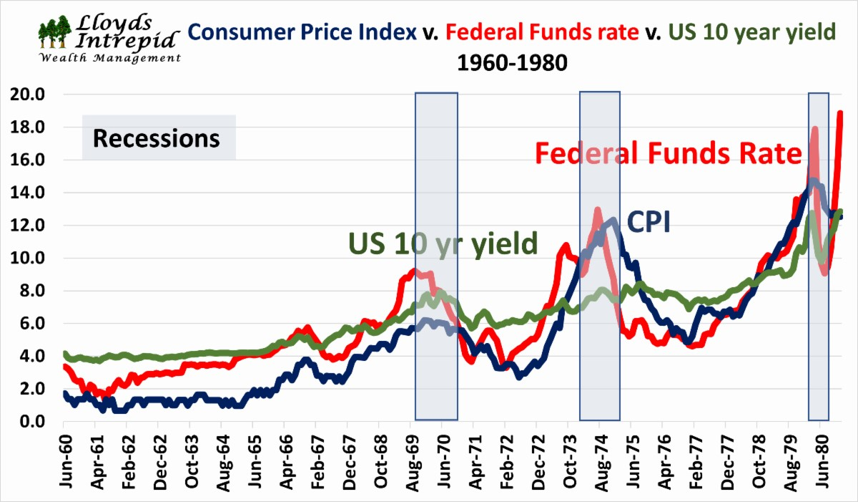
It is hard to come up with a list of factors that indicate falling inflation or deflation. Between Congressional spending, Federal Reserve stimulus, war interruptions to commodity flow and lower taxes, many factors are in place for an extended rise in inflation. Inflation is not a disaster for all investments. Some assets like commodities, precious metals or even cash do quite well in an inflationary environment. Others, such as small cap stocks, large cap stocks, real estate, and bonds do quite poorly.
Notice that Morningstar is quoting returns for very narrow time periods in the prior table. During the 1960s and 1970s, the rise in inflation and interest rates was not stable, but rather had long periods when it rose, punctuated by short periods of decline. We expect something similar to happen over the next 10-20 years because the Fed will ultimately have to step in and deal with the inflation they created. But as with all government operations, it will be clumsy and affected by politics. For now, we are in the period following declining inflation and rate cuts, with inflation just starting to perk up. It is really hard to come up with a scenario where interest rates fall across the board.
Figure 14: Inflation and interest rates 1960-1980 (LIWM)
Final thoughts
In early May, we rebalanced our portfolios to reflect the No war, no peace, no oil scenario. In the Dynamic portfolios, we increased our equity exposure but are still underweight stocks. We will hold this underweight until the Strait of Hormuz re-opens. We are expecting very painful gasoline and diesel markets in June and July. In the equity portfolios, we are pursuing a barbell strategy around commodities and technology: overweight gold, gold miners, commodities, oil companies, software companies, defense companies and the technology sector. This is alongside our core S&P 500 equity positioning. In the bond portfolios, we significantly reduced our core bond holdings and have a large inflation resistant allocation to short-term US treasury bills. By now, many investors recognize that President Trump conducts foreign policy with one eye on the stock market. The current ceasefire has contributed to rallies in April and May. What that means is that a resumption of bombing or a landing of ground forces will be taken as a bearish sign for the stock market. We are watching this closely. As always, we are happy to discuss our research with you and how it affects your situation.
Lloyds Intrepid LLC is an Investment Advisor registered with the State of Texas, where it is doing business as Lloyds Intrepid Wealth Management. All views, expressions, and opinions included in this communication are subject to change. This communication is not intended as an offer or solicitation to buy, hold or sell any financial instrument or investment advisory services. Any information provided has been obtained from sources considered reliable, but we do not guarantee the accuracy, or the completeness of, any description of securities, markets or developments mentioned. We may, from time to time, have a position in the securities mentioned and may execute transactions that may not be consistent with this communication’s conclusions. Please contact us at 281.886.3039 if there is any change in your financial situation, needs, goals or objectives, or if you wish to initiate any restrictions on the management of the account or modify existing restrictions. Additionally, we recommend you compare any account reports from Lloyds Intrepid LLC with the account statements from your Custodian. Please notify us if you do not receive statements from your Custodian on at least a quarterly basis. Our current disclosure brochure, Form ADV Part 2, is available for your review upon request, and on our website, www.LloydsIntrepid.com. This disclosure brochure, or a summary of material changes made, is also provided to our clients on an annual basis.
This update was originally sent as our monthly email newsletter. View the original email.