
What happened to the energy stocks this year and why do tech stocks continue to dominate the headlines? Short answer: the technology and communications sectors generate 10 times the earnings of the energy sector. Money talks.
Market Update – September 2026
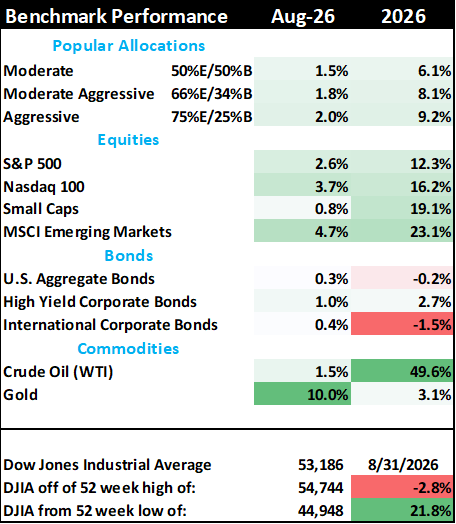
The stock market rose in August led by energy, technology and healthcare. Each sector had unique catalysts to drive up performance. Utilities, real estate and industrials did poorly as long-term interest rates rose, discouraging investors in these sectors. The bond market rose slightly during the month, despite the rising fears of a September rate hike. There is a paradox of inflation occurring in the bond market: higher short-term rates eventually mean lower long-term rates, and vice versa. Today short-term rates are steady while long-term rates edge up. The on-again, off-again war with Iran is back on. We see missiles, bombs and words getting flung back and forth. In Ukraine, Russia has significantly increased its bombing of Kiev. Tensions in east Europe are getting worse. Again, this will have little effect on US stocks as the focus is on the data center buildout.
Broad market performance
Table 1: Market performance estimates as of 8/31/2026 (LIMW)
Market Commentary
The stock market moved higher in August and money flowed into technology, healthcare and energy stocks. Technology stocks continue to benefit from the high, on-going investment into artificial intelligence (AI). While research on the ground is sketchy, there are reports that revenue growth for the providers of AI like Anthropic and Google are strong. If there are limits to growth, the limit seems to be on computing capacity. What this means is that the pressure to build data centers remains high. We expect this to drive strong technology sector revenue and earnings growth well into 2027. Energy stocks keep reacting to the headlines coming out of the Persian Gulf and in general performing better than the raw price of crude oil. Government control of strategic petroleum reserves (SPRs) allowed the governments to suppress the price of oil globally. The prices of diesel and gasoline do not have this type of backstop, so prices here are very strong. Companies with large refining businesses like ExxonMobil and Chevron are natural beneficiaries of this situation.
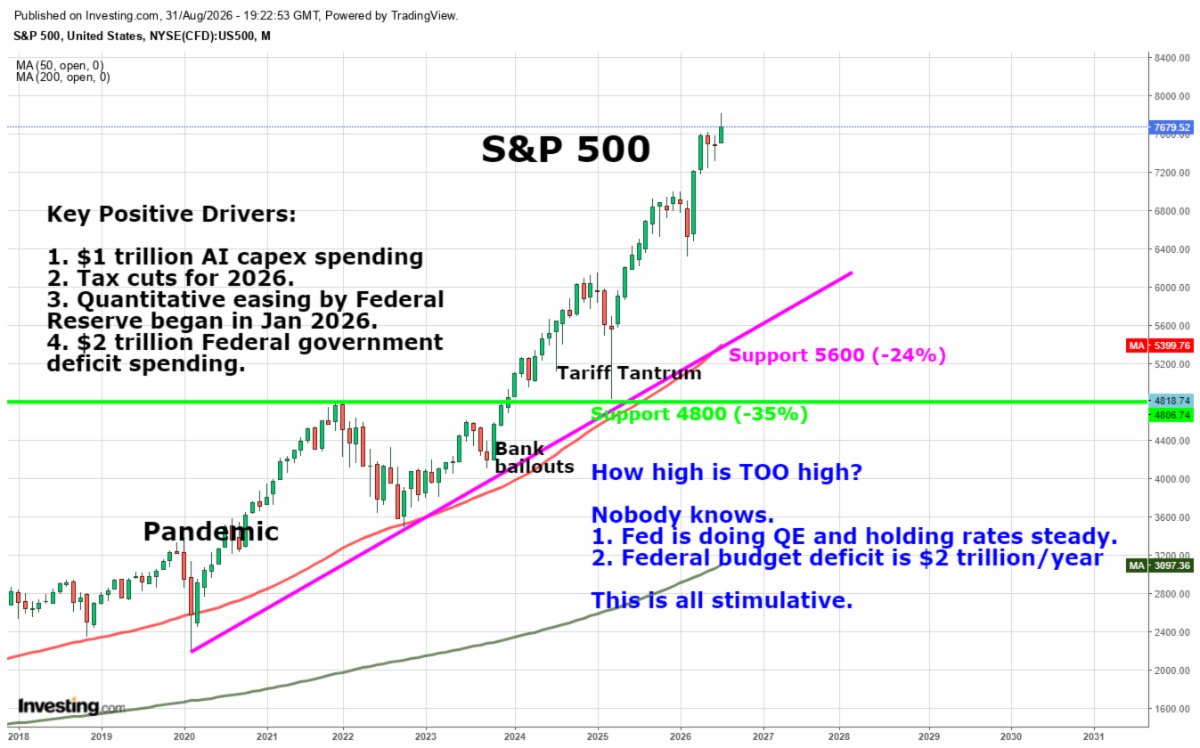
Figure 1: S&P 500 2018-2026 (LIWM)
Earnings are very strong Earnings are a lagging indicator, but one that Wall Street follows quite closely. What is remarkable about earnings as we study the last few quarters and look into 2027 is the strength of the growth. Normally, this type of earnings growth is only seen AFTER a plummet usually caused by a recession. In the chart below, look at the line for 2020 and compare it to the line for 2027. Do you see how different they look? Again, this is reflective of 3 massive factors driving earnings up: Tremendous government spending Enormous capital expenditures for artificial intelligence data centers Healthy consumer spending.
But, what if we are in a bubble? How far can this thing go? Jeff Weniger created this handy chart to compare today’s market with prior massive bull markets. Just based on the price behavior alone, we still have not exceeded the excesses of the 2000 market top.
Non-technology sectors are also generating solid growth in revenues and earnings. Consumer Staples, Financials and Industrials all show remarkable growth over the last 10 years. Of course, the fear for all investors is that this growth is all just evidence of inflation rippling through the economy. There is some evidence that we are reliving the 1970s inflation experience. The Federal Reserve and Treasury department do not seem concerned about inflation at this point. It is primarily the poor and middle class who are suffering as their wages fail to keep up with the rising cost of living.
Why can’t energy stocks get any respect?
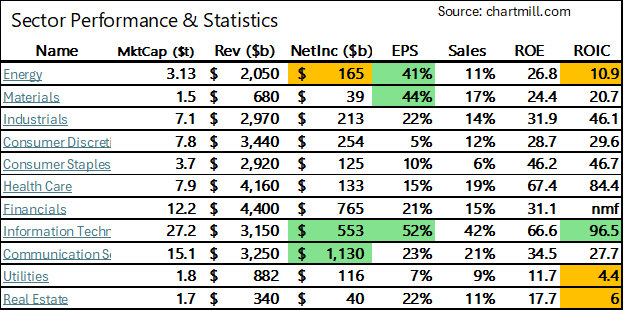
Houston is an energy town and many readers wonder why energy stocks don’t perform better. The simple answer is PROFITS. As profitable as our energy companies are, they pale in comparison to the giants in the technology and communications sector. These are household names like Microsoft, Facebook, Google, Nvidia and Apple. You probably have one of their products with you right now. Let’s review how the various sectors stack up in terms of their key factors:
Mkt Cap – Market Capitalization (number of shares outstanding X stock price) Revenue – billions of dollars for 2025 Net Income – billions of dollars for 2025 EPS – Earnings per share growth Sales – Sales growth ROE – Return on Equity ROIC – Return on Invested Capital
Table 2: Sector comparison of revenue and net income (Chartmill.com and LIWM)
It is easier to see the differences in a bar chart, so the next two figures compare the revenue and net income summaries by sector. You can see the extreme disparity between the various sectors, even ones that you know are fairly profitable.
Figure 5: 2025 Revenue by sector (LIWM)
It is shocking to see how profitable Google and Facebook are in the Communications Services sector. Their profits dwarf even the Technology sector. Energy, Consumer Staples and Utilities are critical sectors for our day-to-day needs, but those businesses are not nearly as profitable as Communications, Financials and Technology. This is the reason Energy can’t get any respect. The profits just aren’t big enough. Figure 6: Net Income by sector (LIWM)
Looking into 2027
Is there anything that can stop the Technology and Communications juggernaut? Perhaps. All the new data centers require enormous quantities of water and electricity. If you go back to Table 2, notice the Utilities Return on Invested Capital: 4.4%. Why would any utility company rush to provide capacity with such poor returns? They won’t. Is there anything that will encourage Utility and Energy companies to provide more capacity? Yes: higher prices and better returns on capital. This fits into our thesis that we are beginning to repeat the 1970s. During that decade, energy and utility companies were big beneficiaries of inflation and rising demand. Guess which sectors did poorly in that environment? Technology and Consumer stocks. That will be our focus in 2027. For now, we follow the money in Technology and Communications.
One other factor stock market investors are ignoring is the grind higher in long-term yields. There is a narrative that the economy is growing so fast it can easily handle higher interest rates. This may be true, but that is exactly the narrative that was floating around in 2006-2007 when the Fed raised interest rates to 5.5%. It turned out the higher interest rates DID matter, but the damage took time to materialize. It is amazing that you can barely even pick out 2008 on this long-term chart. Figure 8: Trend in long-term yields (Bloomberg)
Final thoughts
It is normal to see the markets chop in September and October each year. If the Fed doesn’t raise interest rates, we expect the market swings to be minor. If the Persian Gulf and Ukrainian wars remain contained, we expect the market to slowly work higher. As always, we are happy to discuss our research with you and how it affects your situation.
Lloyds Intrepid LLC is an Investment Advisor registered with the State of Texas, where it is doing business as Lloyds Intrepid Wealth Management. All views, expressions, and opinions included in this communication are subject to change. This communication is not intended as an offer or solicitation to buy, hold or sell any financial instrument or investment advisory services. Any information provided has been obtained from sources considered reliable, but we do not guarantee the accuracy, or the completeness of, any description of securities, markets or developments mentioned. We may, from time to time, have a position in the securities mentioned and may execute transactions that may not be consistent with this communication’s conclusions. Please contact us at 281.886.3039 if there is any change in your financial situation, needs, goals or objectives, or if you wish to initiate any restrictions on the management of the account or modify existing restrictions. Additionally, we recommend you compare any account reports from Lloyds Intrepid LLC with the account statements from your Custodian. Please notify us if you do not receive statements from your Custodian on at least a quarterly basis. Our current disclosure brochure, Form ADV Part 2, is available for your review upon request, and on our website, www.LloydsIntrepid.com. This disclosure brochure, or a summary of material changes made, is also provided to our clients on an annual basis.
This update was originally sent as our monthly email newsletter. View the original email.