
Rising inflation and higher interest rates should be a major headwind for the stock market, except that hasn’t happened. Instead, an incredible burst of earnings growth driven by the data-center buildout has carried the market to new highs.
Market Update – October 2026
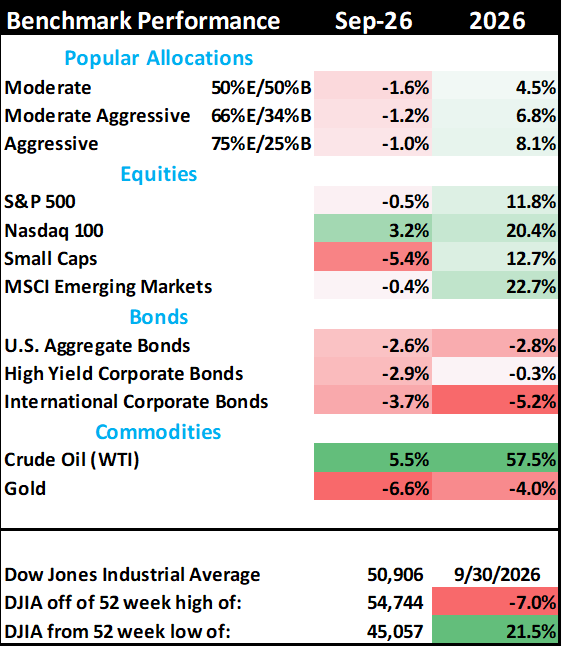
The stock market was unchanged in September, but there was tremendous churn underneath the surface. Technology stocks were up 6%, while nearly all other sectors fell. Basic Materials, Financials, and Real Estate were particularly weak falling 6-7%. The bond market fell during September, especially long-duration bonds maturing in 10 or 20 years. The only place to hide were in short-term Treasuries, CDs and money market funds. The Federal Reserve raised interest rates by 25 basis points; the bond market was not impressed and sold off. Crude oil prices rose during September with no signs of peace between Iran, the United States and Israel. Precision ballistic missile attacks on key infrastructure seem impossible to defend.
Broad market performance
Table 1: Market performance estimates as of 9/30/2026 (LIMW)
Market Commentary
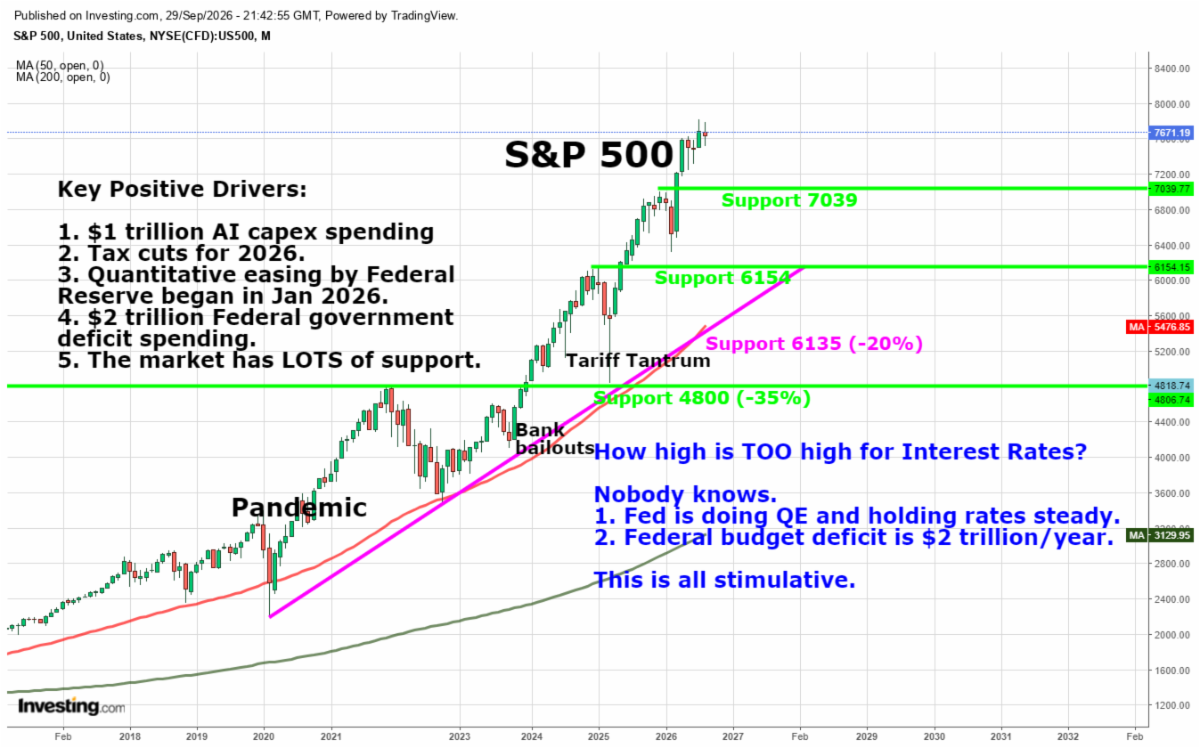
The stock market churned sideways as money rotated from sectors with weak earnings growth to the technology sector where data-center construction is driving remarkable earnings growth. There is not much new on this front. Trillions of dollars are going to be spent this year on the buildout for data-centers that support artificial intelligence (AI). It is very difficult to get hard numbers on whether this business will be profitable and whether these enormous investments will generate a reasonable rate of return. For the large tech players, this is an existential moment. They all see that to the winner will go the spoils. Just as Microsoft came to dominate desktop software and Google dominates internet search, the major technology companies are investing to win the top spot in the AI world. The stock market itself is remarkable well supported. Between robust earnings and very brief pullbacks, there are very few signs of trouble in the short term. We are bullish going into the end of 2026. Next year will be a different story. As discussed below, inflation is rising, interest rates are rising and the world may become dangerously short oil products. The refinery damage in the Mideast and Russia are starting to create big problems in the diesel and gasoline markets. Modern society takes for granted the historically robust supply chains behind these key transportation fuels. Can you imaging living without trucks or cars?
Figure 1: S&P 500 2018-2026 (LIWM)
Earnings are very strong
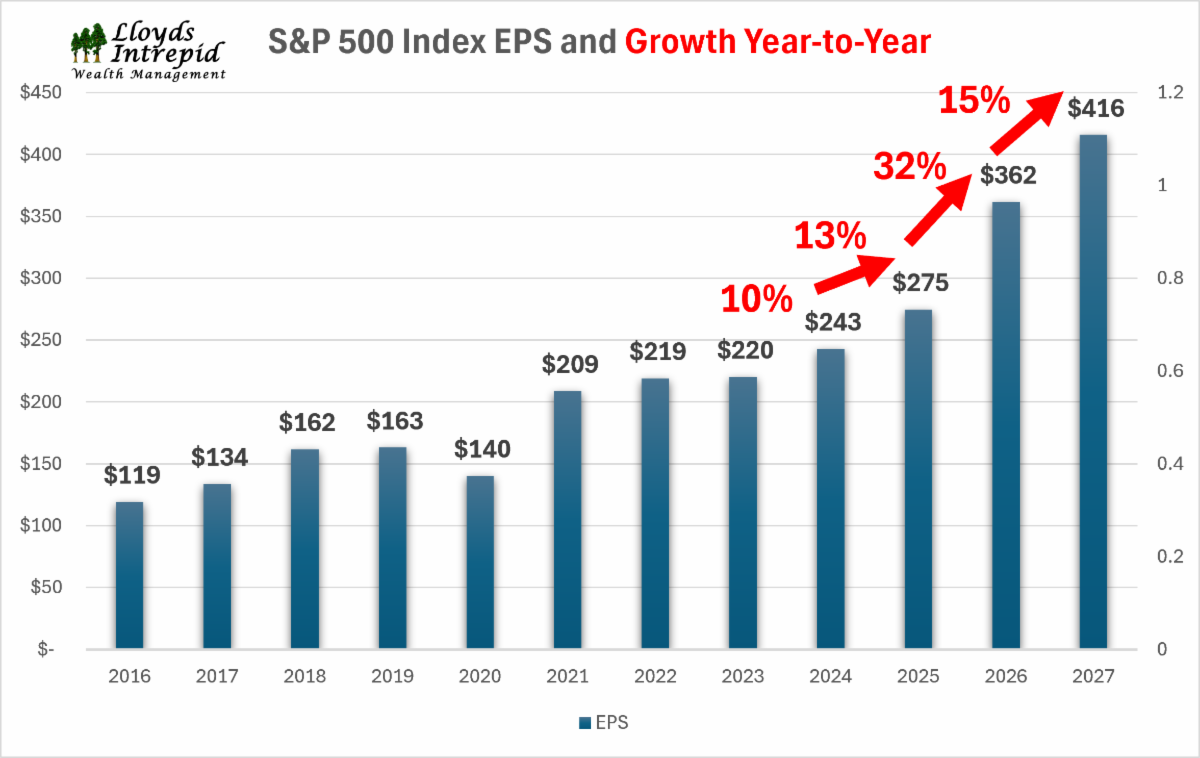
It is hard to overstate the unusual state of corporate earnings. Typically, when you come out of recession, there is a dip in earnings followed by a big bounce up. Today, we see high earnings accelerating even higher as the tech companies spend heavily on the AI data-center buildout. In the chart below, you can see broad S&P 500 earnings have grown 10% in 2024, 13% in 2025, and 32% in 2026. Most of these new earnings are generated in the technology sector. While there are similarities to the 2000 technology bubble, one key difference is that today the players investing the money are not penniless start-ups. They are highly profitable behemoths like Microsoft, Google, Facebook and Amazon. This means that a market pullback may NOT stop investments in this area. The one factor we are watching closely is capital spending (capex) by these large firms. They will pull back on their capex spending long before problems show up in their revenues or profits.
Figure 2: S&P 500 earnings by year and year on year growth (LIWM)
Inflation, yields and Fed policy
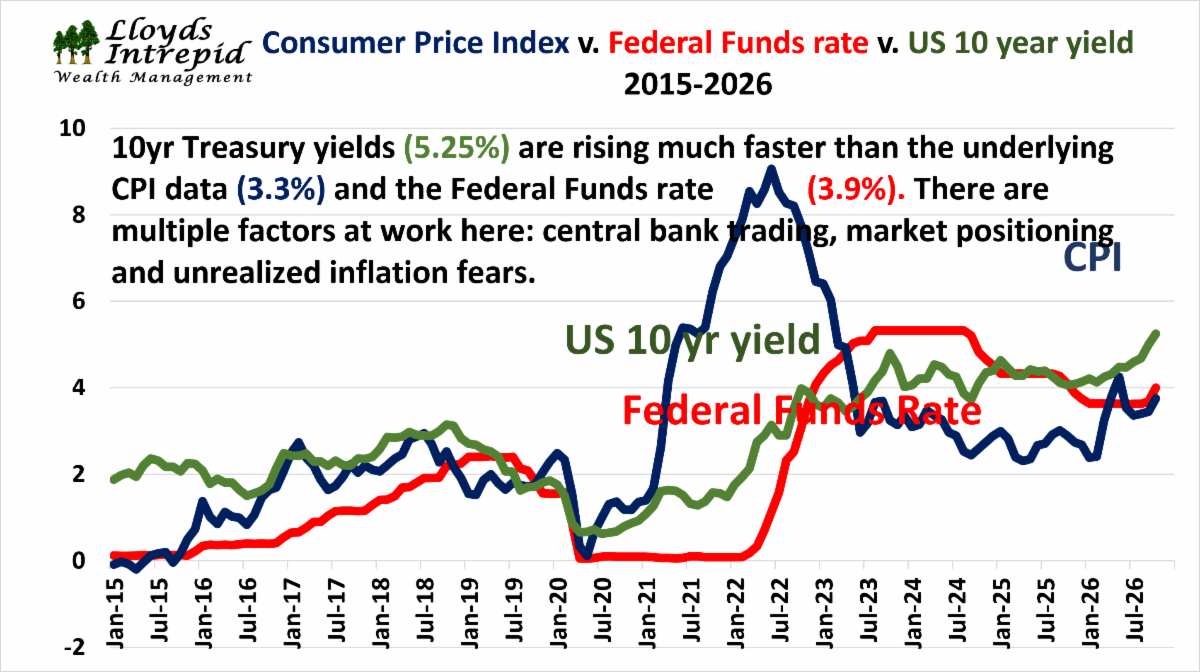
Inflation is rising and there is fear that energy prices may trigger another spike similar to what we saw in 2021 and 2022. While possible, that is not what we see in the data. You can see below that total inflation is popping up from the lows of 2024 and 2025, but not alarmingly so. The recent inflation data is modest enough that the Fed may not raise rates as many feared in October.
Figure 4: Consumer Prices, Federal Funds rate, and 10-year Treasury bond yields (LIWM)
Bond markets are worried
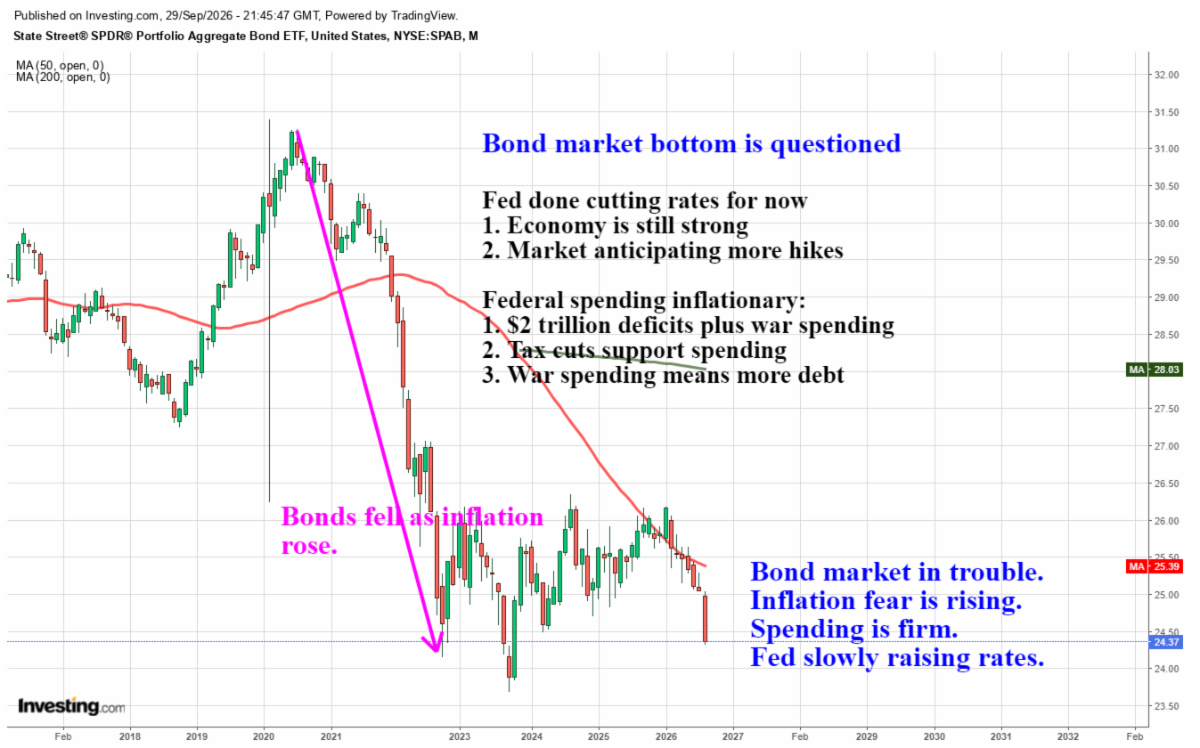
Many investors hope that modest inflation readings would calm down the bond markets and allow long-term yields to fall. This would be a bullish backdrop for the bond portfolios of the portfolios. Instead, the bond market is struggling with several different factors: The lower CPI readings imply the Fed won’t raise rates, allowing inflation to run hot again. Central banks that hold US Treasuries for reserve purposes are losing money on those investments and may be selling. Countries like Japan with weak currencies may be selling their Treasury holdings to manage currency risk. The Federal Reserve is doing quantitative easing which pushes cash into the trading markets. The Federal Reserve is buying short-term, not long-term bonds as part of their current quantitative easing policy. The US economy is growing rapidly; economic growth creates inflation. The result is a significant weakening of bonds over the last few months.
Figure 5: Broad bond benchmark pricing 2018-2026 (LIWM)
The Sum of All Fears
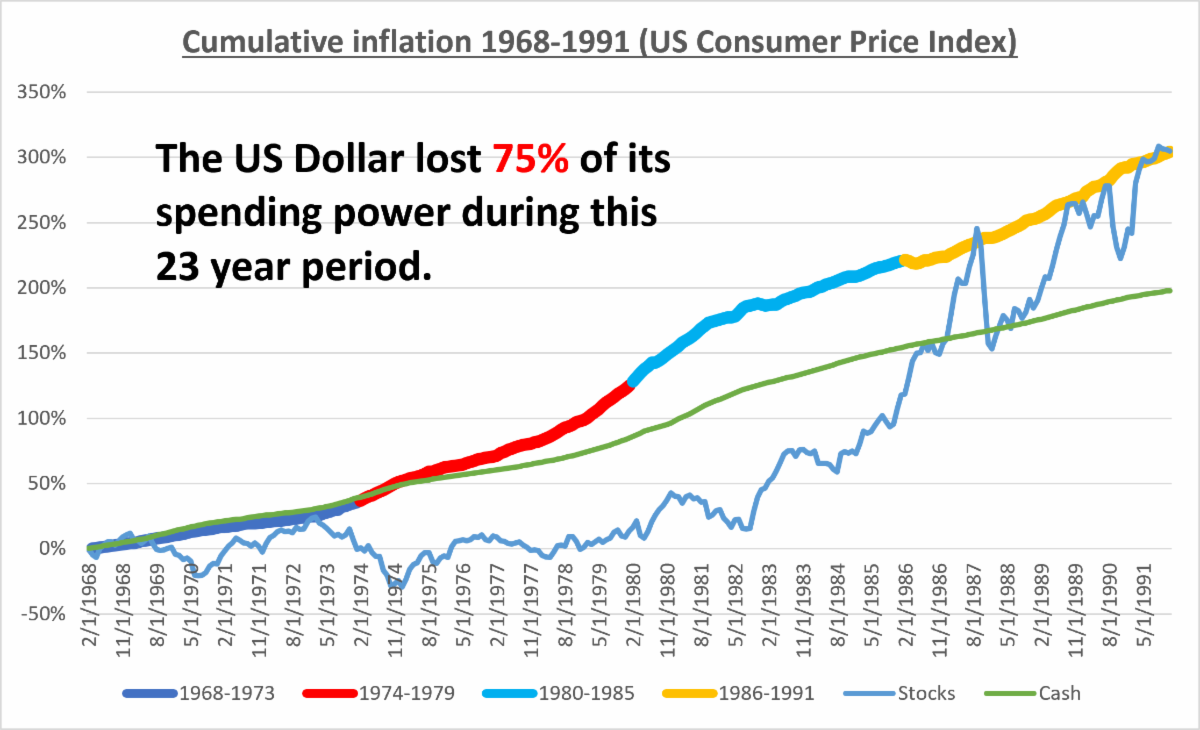
When you add up all the factors affecting inflation, one may start thinking about the 1970s. In particular, you may ask yourself how bad was it and how will I manage through another repeat of that awful decade. Here is your number: 75% The US Dollar lost 75% of its spending power during the 1968-1991 period. Bonds performed horribly during this period, but cash and stocks did ok. What does that mean for us today? There will be times when holding bonds will not be defensive. For example, for much of the spring and summer, we were very underweight bonds and held those proceeds in 3-month Treasury bond ETFs. This was essentially cash yielding 3.6%. This positioning allowed us to miss some of the summer bond sell-off.
Figure 6: Cumulative inflation (CPI) 1968-1991 (LIWM)
Final thoughts
We used the market chop in September to rebalance the portfolios significantly. Our dynamic portfolios are overweight stocks and our view is bullish for the rest of the year. In the stock portion of the portfolios we are overweight technology, defense, gold, communications, energy and utilities. In the bond portion of the portfolios, we have moved out of our heavy cash holdings in 3-month Treasuries and invested fully into the broad bond market during the September sell-off. Our view on the tug-of-war between interest rates and earnings is that for now, earnings are strong enough to push through higher interest rates. The technology sector is cyclical, but not sensitive to immediate changes in yields. However, higher interest rates eat away at the foundational growth of the broad economy. Eventually, interest rates may affect growth, slowing down the economy. That will likely be a 2027 discussion. As always, we are happy to discuss our research with you and how it affects your situation.
Lloyds Intrepid LLC is an Investment Advisor registered with the State of Texas, where it is doing business as Lloyds Intrepid Wealth Management. All views, expressions, and opinions included in this communication are subject to change. This communication is not intended as an offer or solicitation to buy, hold or sell any financial instrument or investment advisory services. Any information provided has been obtained from sources considered reliable, but we do not guarantee the accuracy, or the completeness of, any description of securities, markets or developments mentioned. We may, from time to time, have a position in the securities mentioned and may execute transactions that may not be consistent with this communication’s conclusions. Please contact us at 281.886.3039 if there is any change in your financial situation, needs, goals or objectives, or if you wish to initiate any restrictions on the management of the account or modify existing restrictions. Additionally, we recommend you compare any account reports from Lloyds Intrepid LLC with the account statements from your Custodian. Please notify us if you do not receive statements from your Custodian on at least a quarterly basis. Our current disclosure brochure, Form ADV Part 2, is available for your review upon request, and on our website, www.LloydsIntrepid.com. This disclosure brochure, or a summary of material changes made, is also provided to our clients on an annual basis.
This update was originally sent as our monthly email newsletter. View the original email.