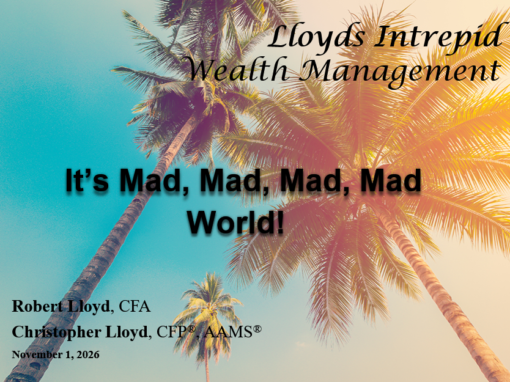
It’s a Mad, Mad, Mad, Mad World was a 1963 comedy about a group of strangers rushing to dig up a suitcase full of cash in California. The cash was buried under the “Big W” which nobody could see because it was formed by the palm trees in the background. Today’s markets reminded us of that movie because many analysts and investors keep asking “is this the top?”, or “is it like 1999?”, or “is a crash imminent?” Like the characters in the movie, they look everywhere but can’t see the answer staring them in the face. (If you haven’t seen the movie, I highly recommend it: Spencer Tracy, Milton Berle, Sid Caesar, Buddy Hackett, Ethel Merman, Mickey Rooney, Jonathan Winters, and Phil Silvers. All the comedy greats of the 1960s. Stream it for free on Pluto.)
Market Update – November 2026
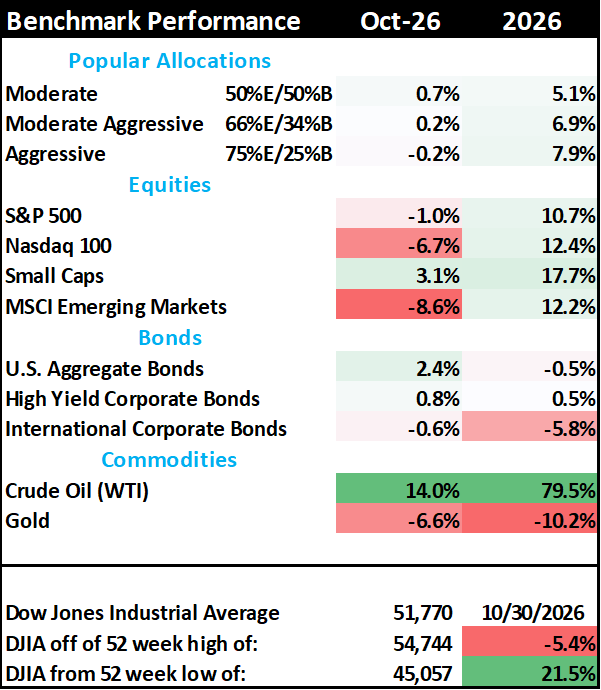
The stock market experienced a classic “risk-off” rotation in October. Technology and Communications stocks fell 8% and 10%, respectively, while Energy, Utilities, and Staples rose 14%, 11%, and 10%. The war with Iran drove up the price of oil pulling Energy stocks up; conversely, Google, Amazon and Intel delivered bad news on their quarterly earnings announcements. The bond market rose in October as part of the “risk-off” rotation found its way into investment grade and long-duration bonds. Additionally, the Federal Reserve declined to raise interest rates. Crude oil prices rose during October with no signs of peace between Iran, United States and Israel. There are rumors that the war will see an increase in hostilities after the November 3rd election. Even with October’s poor performance, stocks are on track to experience another year of above average performance. Bonds are a different story, unfortunately.
Broad market performance
Table 1: Market performance estimates as of 10/31/2026 (LIMW)
Market Commentary
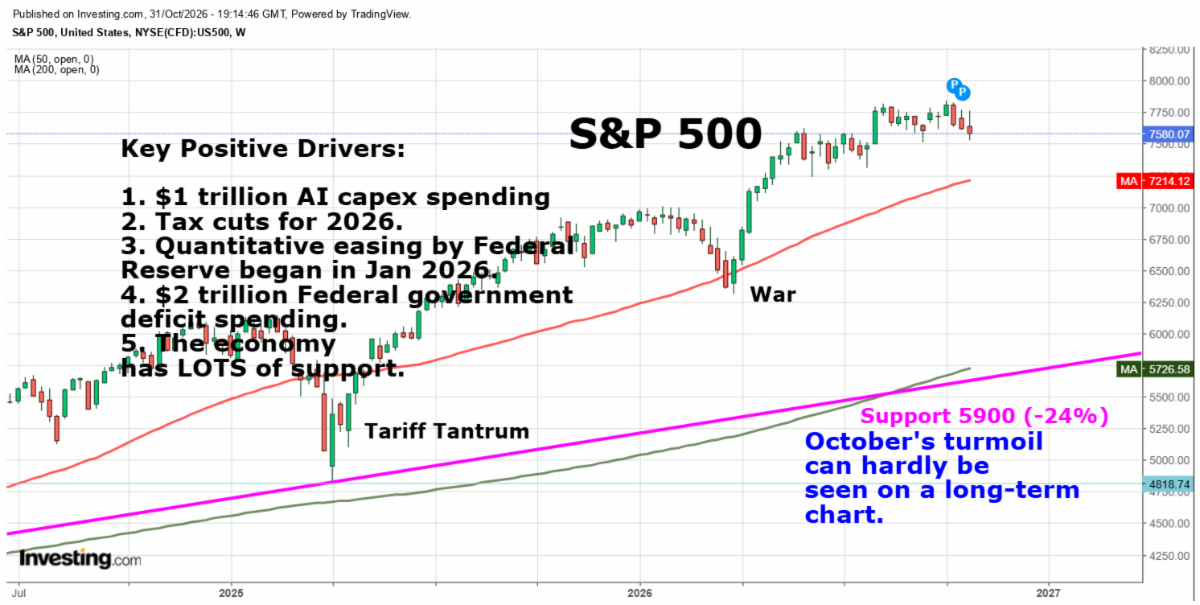
October was another choppy month for stock market investors. But in the grand scheme of things, the current bull market was not damaged. There are three factors looming over the market: politics, oil and tech spending. On the political front we have an important mid-term election on Tuesday. Some investors are wondering what policy changes might happen when the new Congress comes in. Historically, the resolution of an election is usually bullish because uncertainty is resolved regardless of which party wins. A secondary political issue is where the Fed is taking interest rates. In October, they did not raise rates, helping to lift the bond market. There is no denying that the US has a big inflation problem. The bond market is expecting more rate increases in 2027. The oil market is worried about the Persian Gulf. Despite assurances that oil is flowing, crude oil prices rose significantly during October and the Energy sector stocks traded to new highs. Oil prices affect many parts of the economy with higher oil prices acting as an economic headwind for consumers. Finally, technology spending on data centers continues at a blistering pace. Google and Amazon recently delivered poor quarters because of their investments in the artificial intelligence space. However, the indications from Anthropic’s imminent IPO justify many of these investments into AI. There is real money on the table for the players to grab. One interesting development from Intel and Apple’s recent announcements was that higher memory prices are affecting demand for traditional computers and cellphones. There is a limit to what the consumer will pay for these devices.
Figure 1: S&P 500 2018-2026 (LIWM)
Is it a bubble like 1999? – yes, no, maybe
Do you remember 1999 and 2000? The late 1990’ss were an extraordinary time for the United States. The economy and stock market were booming, jobs were plentiful and the pay was good. Sure, there were problems, but the new internet economy captivated the public and investment community. For investors comparing 1999 and 2026, there are important similarities and differences.
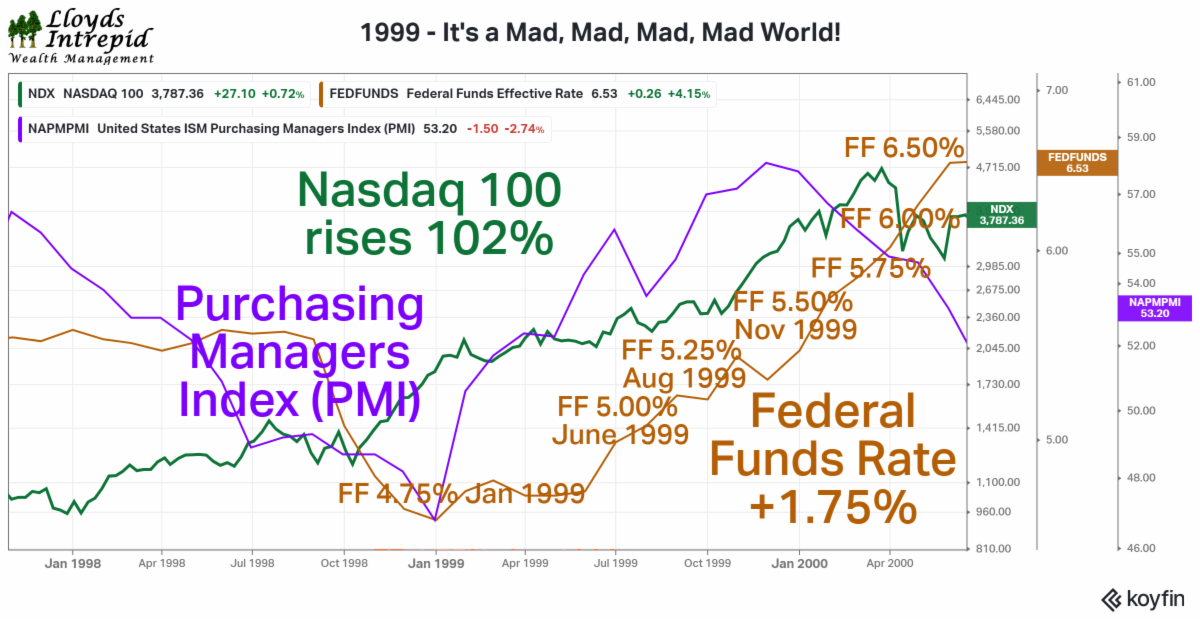
The focus of most equity investors is the semiconductor and artificial investor space. From this perspective, the investment narrative is similar. In 1999, internet search and computer software required frequent upgrades in hardware to accommodate the needs of users. This drove tremendous demand for chips and software. Today, artificial intelligence is also driving the construction of data centers that are hungry for power, water, and semiconductors. However, a key difference is that today’s new businesses are generating incredible revenue. For example, Anthropic, the private company that developed the Claude AI tool, is expected to generate $60-74 billion in revenue this year! Do you see why the technology giants are spending like crazy to capture the AI space? There is REAL money on the table for whoever wins this race. So, what happened to stop the party in 1999? One key factor was the Federal Reserve who raised their policy interest rate from 4.75% to 6.5%. This was high enough and long enough to prick the investing bubble and trigger a long and severe recession. While they were doing this, the economy grew like gangbusters and the Nasdaq index more than doubled.
Figure 2: The party of 1999: Nasdaq, PMIs, and Federal Funds Rate (LIWM)
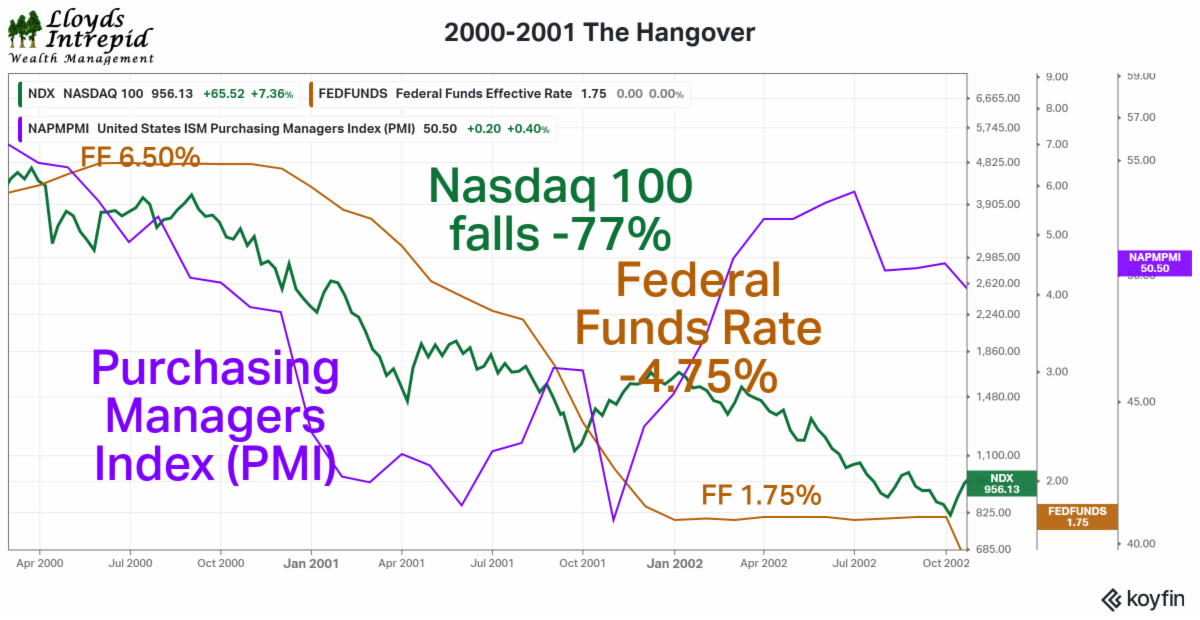
Of course, you all remember how the story ended. After the party, there was a huge hangover. The Nasdaq fell 77% over the next two years, the country slipped into recession and the Federal Reserve was forced to cut interest rates to 1% to restart the growth engine. While some market historians call this a market crash, at the time what investors experienced was water torture. Each day, week and month, the market gradually fell. There was no crash like the 1987 market event. In both Figure 2 and Figure 3, notice how the Purchasing Manager Index (PMI) PEAKS before the market and BOTTOMS before the market.
Figure 3: The hangover 2000-2002: Nasdaq, PMIs, and Federal Funds Rate (LIWM)
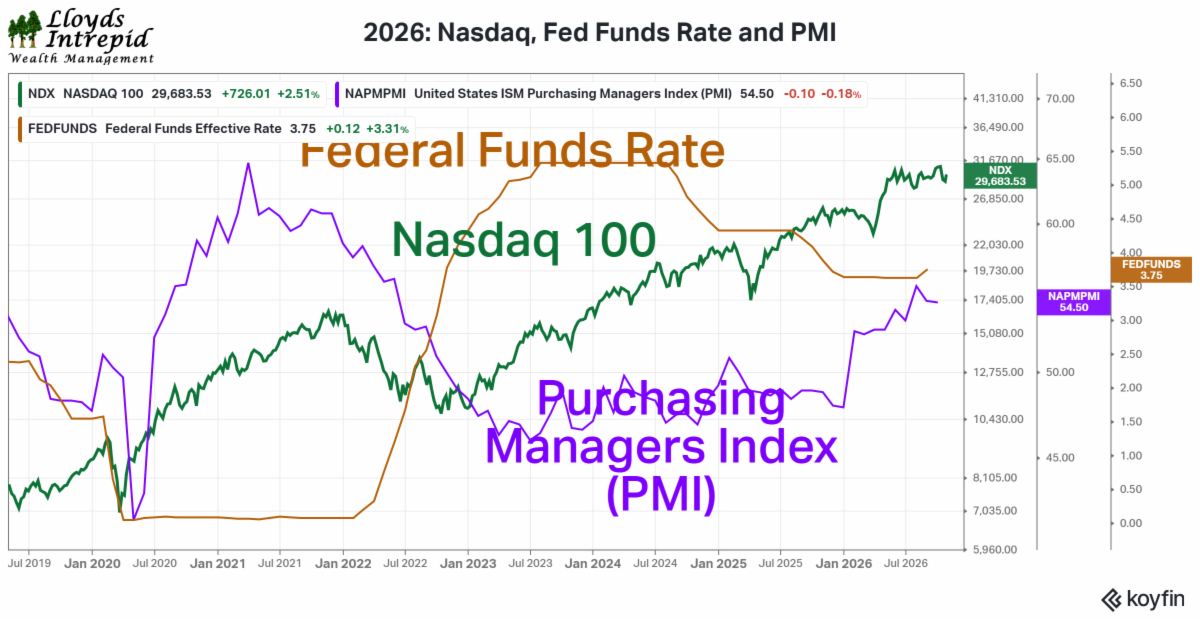
This analysis is helpful because it puts today’s market into context. Is the Fed about to embark on an extensive rate hiking cycle? The inflation numbers could certainly justify that policy, but they haven’t done it yet. Are technology stocks at ridiculous valuations? Not like 1999. Is this a late-stage bull market? Yes, but the signs of recession are not present. What are the key differences between today and 1999 in this analysis: We have an oil crisis building alongside a Mideastern war. BEARISH The Federal government is spending very heavily. BULLISH The companies funding the tech bubble have plenty of cash to invest. BULLISH The PMIs indicate the economy is ACCELERATING today, while in 1999 there was SLOWING. BULLISH
Figure 4: Today’s Nasdaq, PMI, and Federal Funds Rate (LIWM)
Final thoughts
October was another disappointing month for investors as war, tech spending and political uncertainty dominated everyone’s thinking. We are still bullish on stocks going into the end of the year. Higher oil prices, while annoying, don’t seem to be sapping consumer spending. Tech spending is still going strong and companies like Google and Amazon have plenty of cash to invest. Finally, the election will resolve uncertainty, regardless of who wins and your political persuasion. As always, we are happy to discuss our research with you and how it affects your situation.
Lloyds Intrepid LLC is an Investment Advisor registered with the State of Texas, where it is doing business as Lloyds Intrepid Wealth Management. All views, expressions, and opinions included in this communication are subject to change. This communication is not intended as an offer or solicitation to buy, hold or sell any financial instrument or investment advisory services. Any information provided has been obtained from sources considered reliable, but we do not guarantee the accuracy, or the completeness of, any description of securities, markets or developments mentioned. We may, from time to time, have a position in the securities mentioned and may execute transactions that may not be consistent with this communication’s conclusions. Please contact us at 281.886.3039 if there is any change in your financial situation, needs, goals or objectives, or if you wish to initiate any restrictions on the management of the account or modify existing restrictions. Additionally, we recommend you compare any account reports from Lloyds Intrepid LLC with the account statements from your Custodian. Please notify us if you do not receive statements from your Custodian on at least a quarterly basis. Our current disclosure brochure, Form ADV Part 2, is available for your review upon request, and on our website, www.LloydsIntrepid.com. This disclosure brochure, or a summary of material changes made, is also provided to our clients on an annual basis.
This update was originally sent as our monthly email newsletter. View the original email.